What Is Crypto Futures Trading? A Beginner’s Guide

Crypto futures trading has gained prominence as digital assets mature into a broader financial ecosystem. By allowing participants to speculate on or hedge against the future value of cryptocurrencies, futures contracts bring a new dimension to market participation — one built on structure, discipline, and defined risk exposure.
This guide explains how crypto futures work, what makes them distinct from spot trading, and the key concepts every beginner should understand before entering the derivatives market.
What is Crypto Futures Trading?
Crypto futures trading involves agreements, known as futures contracts, to buy or sell a cryptocurrency at a predetermined price on a future date. These contracts let market participants gain price exposure without holding the underlying digital asset.
In traditional markets, futures have long been used to hedge against price fluctuations in commodities or currencies. In crypto markets, the same principle applies: traders can open positions on Bitcoin, Ethereum, or other digital assets based on expectations about future price movements.
Unlike spot trading, which involves directly buying or selling cryptocurrencies at current market prices, futures trading is about the future value of those assets. If the price of Bitcoin rises and a trader holds a buy (long) futures contract, they may profit from the price difference at settlement. Conversely, if prices move against the position, the trader incurs a loss.
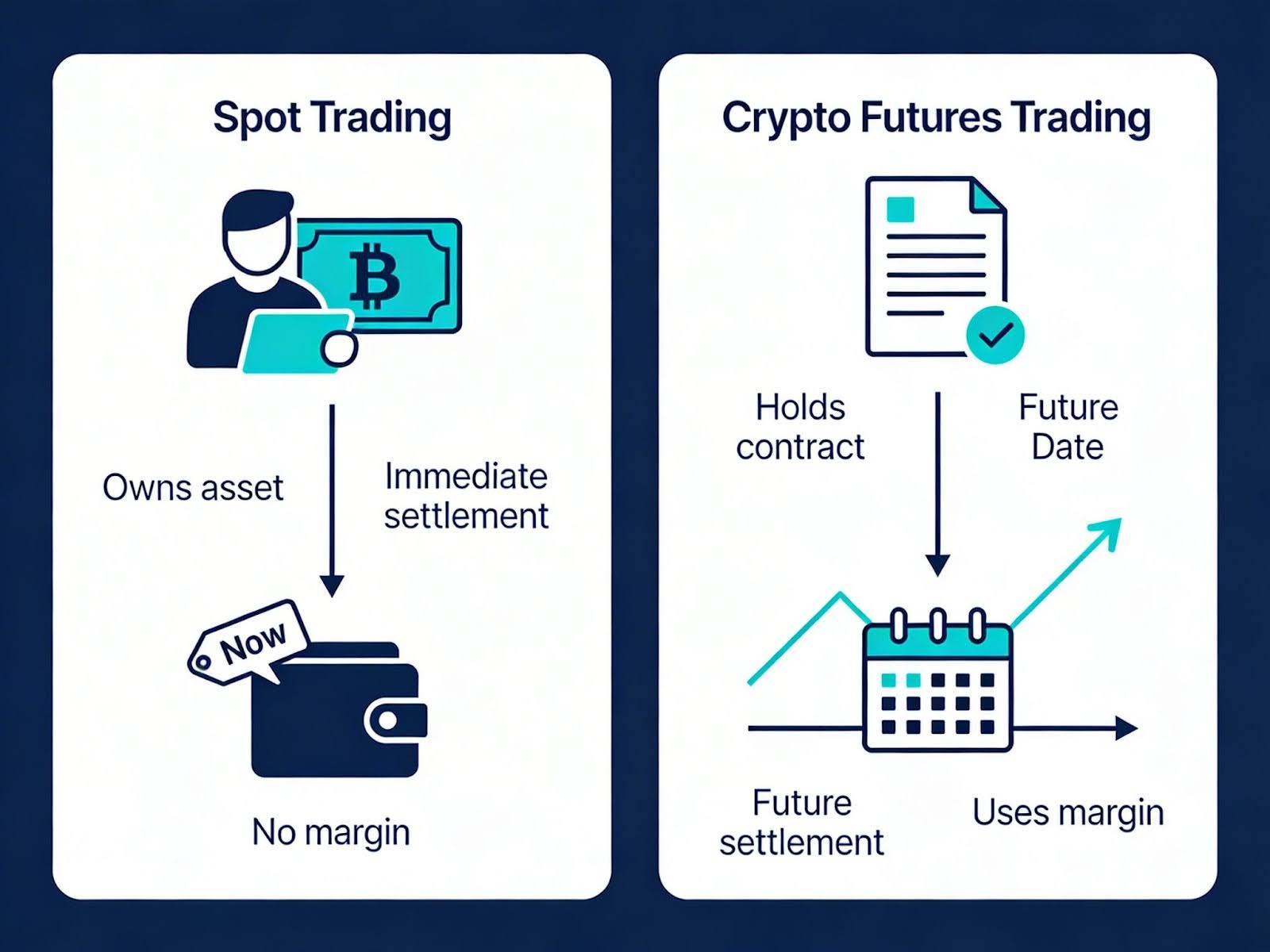
Crypto futures serve both speculative and hedging purposes, offering advanced market tools that can diversify risk exposure. However, they come with more complex mechanics and higher potential for loss than spot trading, making disciplined risk understanding essential before participation.
How Crypto Futures Contracts Work
A crypto futures contract defines specific details: the asset being traded, for example BTC, ETH, the contract size, and the expiration date. Each contract functions as a commitment to buy or sell the designated digital asset at the agreed-upon price once the contract expires.
While traditional futures have fixed expiration dates, such as monthly or quarterly, the crypto market also includes perpetual contracts, which do not expire. These perpetual contracts use a funding rate mechanism to keep their prices aligned with the spot market.
Key pricing terms include the mark price, used for determining unrealized profits and losses, and the last price, the most recent market transaction. The mark price serves to prevent unfair liquidations during brief volatility spikes.
Settlement occurs when the contract ends (or is closed). For expiring futures, settlement may be in cryptocurrency or stablecoins, depending on platform design. For perpetual futures, positions can remain open indefinitely, provided margin requirements are maintained.
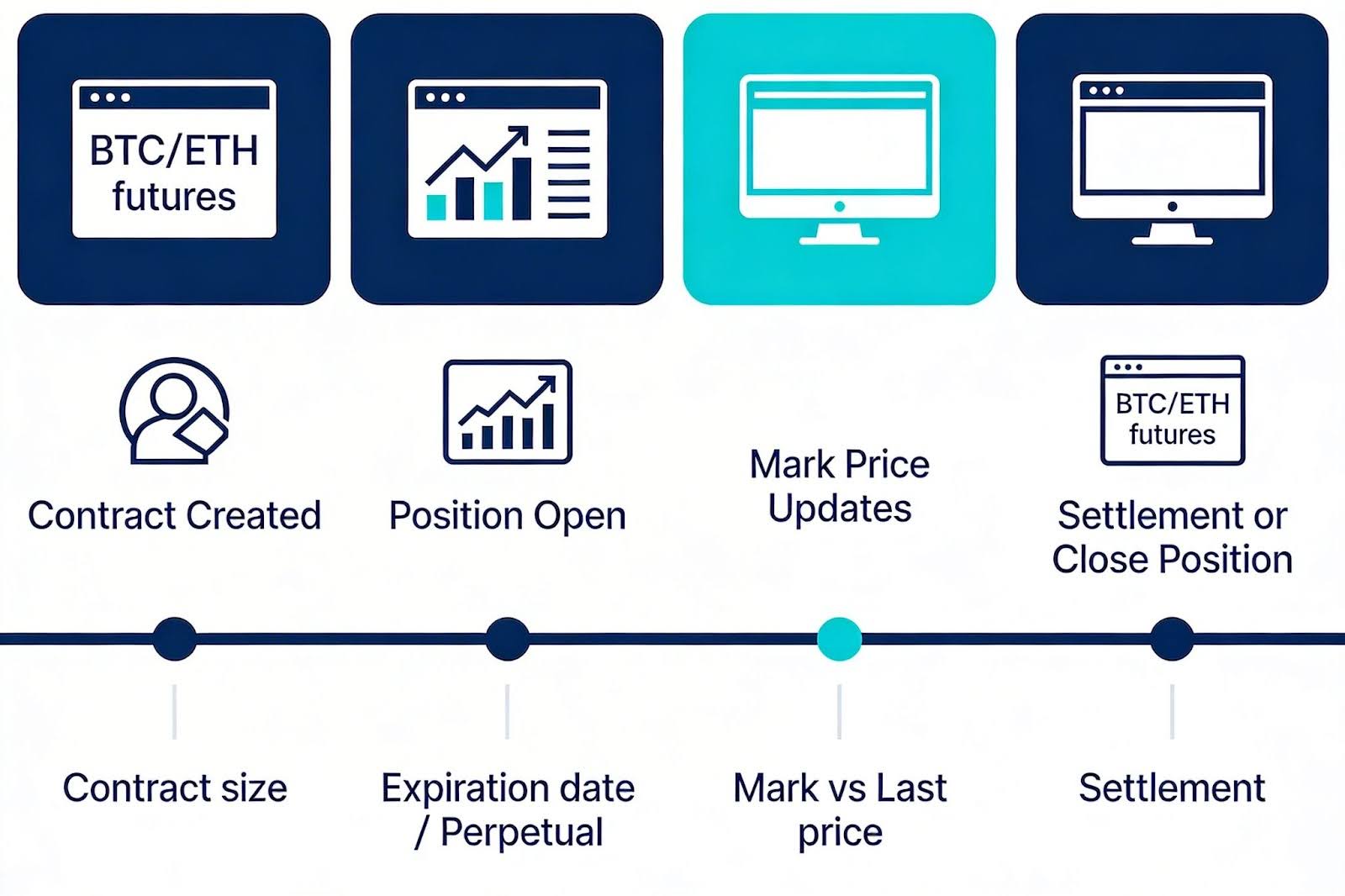
This contract-driven system enables traders and institutions to participate in market movements, manage exposure, and contribute to broader price discovery in the digital asset ecosystem.
Leverage and Margin in Crypto Futures
Leverage allows futures traders to control larger positions than their capital would normally permit by using borrowed funds. However, with potential returns also come amplified risks.
Before opening a position, traders must deposit an initial margin—a portion of the contract’s total value. As the market fluctuates, maintaining adequate capital is critical to avoid liquidation. The maintenance margin is the minimum amount that must remain in an account; if balance falls below this level, the position may be automatically closed to prevent further loss.
Liquidation risk represents one of the most significant factors in futures trading. Even small adverse price movements can lead to forced position closure, especially when high leverage is used. Licensed platforms often employ risk control frameworks that cap leverage and manage systemic exposure.
On OSL Global, perpetual futures are offered with leverage of up to 10x, aligning with a prudent, compliance-driven approach to derivatives trading. Such structured limits reflect OSL’s commitment to responsible risk management under its licensed framework.
Benefits and Risks of Crypto Futures Trading
Crypto futures offer several potential benefits for participants who understand the underlying mechanisms:
Hedging: Futures enable holders of digital assets to mitigate downside risk by taking opposite positions in futures markets.
Price discovery: Active participation in the derivatives market contributes to more accurate asset valuation.
Liquidity: Popular contracts such as BTC and ETH futures attract diverse participants, supporting efficient trade execution.
However, futures also expose traders to distinct risks:
Volatility: Sudden market swings can rapidly change position values.
Liquidation risk: Highly leveraged positions are vulnerable to forced closures.
Funding rate exposure: Holding perpetual contracts can incur or earn funding payments, depending on market dynamics.
Market gaps: Rapid price movements during low-liquidity periods can lead to unexpected losses.
Recognizing these elements helps beginners understand that futures trading, while versatile, requires consistent awareness of evolving market risk conditions.
Crypto Futures vs. Perpetual Contracts
While both futures and perpetual contracts are derivatives, key structural differences set them apart. Traditional futures have fixed expiry dates, meaning profits or losses are realized at settlement. After expiry, new contracts must be opened to maintain exposure.
In contrast, perpetual contracts have no expiry. Instead, they rely on a funding rate, a periodic payment exchanged between long and short traders, to maintain the contract’s price near the spot market rate. When funding is positive, long traders pay shorts; when negative, the inverse occurs.
Perpetual contracts dominate much of the retail crypto derivatives market because they simplify position maintenance while remaining continuously tradable. Yet, the funding mechanism introduces another variable that traders must monitor since long-term holding can incur additional costs over time.
Risk Management Considerations for Beginners
Before trading, beginners should focus on understanding exposure and setting limits aligned with their financial capacity and experience level.
Key principles include:
Position sizing: Only allocate a manageable portion of capital to any single contract.
Volatility awareness: Crypto assets are known for sudden price swings that can affect margin requirements.
Understanding contract terms: Read all terms, such as funding rates, settlement modes, and expiry conditions, before initiating trades.
Platform risk: Choose exchanges that maintain compliance with local derivatives regulation and uphold transparent operational standards.
Each of these factors contributes to informed participation and helps maintain financial discipline in the evolving crypto derivatives market.
Trading Crypto Futures on a Licensed Platform
OSL Group (HKEX: 863) is Asia’s leading stablecoin trading and payment platform, offering licensed digital asset exchange services and compliance-driven infrastructure. Within this framework, OSL Global provides access to perpetual futures contracts on major digital assets, including BTC, ETH, BNB, and SOL.
Perpetual contracts on OSL Global are offered with leverage of up to 10x, reflecting a structured approach to risk management within a regulated derivatives environment. This framework aligns with Hong Kong’s evolving market oversight principles for digital asset trading.
To learn more, explore:
For participants who wish to gain practical experience in a structured environment, OSL Global periodically hosts limited-time perpetual trading events.
Currently, the Peak Performance Perpetual Trading Competition is live, offering a total prize pool of 27,000 USDC. The event includes:
Perpetual Newbie Welcome Bonus – First-time contract traders can receive a 10 USDC bonus upon completing their first futures trade.
Perpetual Ranking Challenge – Qualified participants compete on a trading volume leaderboard and share 17,000 USDC in rewards.
Guaranteed Rewards Pool – Users reaching a defined trading threshold may qualify for additional reward allocations.
Participation rules, eligible contracts, and detailed calculation methods are outlined on the official event page.
👉 Learn more about the futures competition here.
As with all derivatives trading, participants should fully understand margin requirements, leverage limits (up to 10x on OSL Global), and liquidation risk before engaging in any event.
The Takeaway
Crypto futures trading allows participants to gain exposure to the future price of digital assets through standardized contracts rather than direct ownership. It sits within the broader derivatives market, where concepts like contract size, expiration or perpetual structure, mark price, and settlement determine how positions behave over time.
Because futures use margin and can involve leverage, even modest price movements can have a significant impact on account equity, making liquidation risk a central consideration for beginners. Perpetual contracts add another layer with funding rates, which help keep prices aligned with the spot market but also introduce ongoing cost or income depending on market conditions.
For new participants, the most important priorities are understanding contract terms, sizing positions conservatively, recognizing the impact of volatility, and being aware of platform and regulatory frameworks. Using a licensed exchange with defined leverage caps and compliance-driven infrastructure, such as OSL Global, can support a more structured approach to managing these risks while engaging with crypto futures in a disciplined way.
FAQs on Crypto Futures Trading
Is crypto futures trading profitable?
Crypto futures trading can lead to gains or losses, depending on how markets move and how positions are managed. There is no guarantee of profitability, and many participants experience losses, especially when using high leverage in volatile conditions.
Can I trade futures with $100?
Some platforms and products allow futures trading with relatively small account sizes, particularly when using micro contracts and lower margin requirements. However, a small balance limits position sizing and leaves less room to absorb market swings, which can increase liquidation risk in volatile cryptocurrency markets.
What is futures trading with an example?
Futures trading involves agreeing today on a price to buy or sell an asset at a future date. For example, a trader might enter a Bitcoin futures contract to buy 1 BTC at a specified price next month, gaining or losing depending on how the market price compares to that agreed futures price at the time the position is closed or settled.
Is crypto futures trading gambling?
Crypto futures trading and gambling both involve uncertainty and the possibility of loss, but they are not identical activities. Futures contracts are financial instruments within the derivatives market, and outcomes are strongly influenced by factors such as market conditions, risk management, and understanding of contract terms, rather than chance alone.
Start your safe cryptocurrency journey now
OSL | Secure Ramps. Trusted Rails !
More About Topics
More About Topics
Latest
60-Vote Hurdle for CLARITY Act Exposes Limits of Legislative Hope
The CLARITY Act's September 15 procedural vote exposes why implemented regulatory frameworks may offer institutions more operational certainty than pending U.S. legislation.
60-Vote Hurdle for CLARITY Act Exposes Limits of Legislative Hope
XRP Rebounds 30% Then Slips: DeFi Infrastructure Faces Volatility Exam
XRP Ledger's $1.1 billion stablecoin expansion and new lending protocol foundation face an immediate stress test as XRP price swings 30% monthly.
XRP Rebounds 30% Then Slips: DeFi Infrastructure Faces Volatility Exam
$0.325 SKY Forecast: Valuation Model or Institutional Wish?
Standard Chartered's $0.325 price target on Sky's governance token applies bank-style valuation to on-chain credit infrastructure, but the forecast depends on USDS adoption and borrowing expansion that remains nascent.
$0.325 SKY Forecast: Valuation Model or Institutional Wish?
SEC Custody Rewrite Hits White House, Jurisdictional Gap Widens
The SEC's proposed crypto custody rewrite entered White House review on August 25, 2026, leaving U.S. institutional frameworks unresolved while banks and custodians position services under divergent national rule stacks.
SEC Custody Rewrite Hits White House, Jurisdictional Gap Widens
India's $100M Bond Tokenization: A Rights Structure Stress Test
SEBI's Demat 2.0 pilot issued over $100 million in tokenized bonds using digital rupee settlement, but its phased rollout from institutional pilots to secondary trading and retail access tests whether off-chain...
India's $100M Bond Tokenization: A Rights Structure Stress Test
Recommended For You
More About Topics
More About Topics