Bitcoin Price Outlook 2026-2040: Scenarios, Drivers, and Key Risks

Key Takeaways: Bitcoin Price Predictions at a Glance
BTC price predictions vary widely due to uncertainty around regulation, macro liquidity, and large-scale Bitcoin adoption.
Price prediction 2026 is influenced by the post-2024 bull run, ETF inflows, and supply changes after the Bitcoin halving.
Bitcoin price prediction 2030 centers on BTC as digital gold and a store of value for institutional portfolios.
Price predictions for 2040 and 2050 emphasize scarcity, with nearly all 21 million BTC coins mined.
Scenario-based thinking is more useful than relying on a single BTC price forecast.
Bitcoin price prediction models aim to estimate how BTC may evolve over the coming years and decades. By analyzing historical price trends, market cycles, and key supply-demand factors, experts develop forecasts for milestone years such as 2026, 2030, 2040, and 2050. While current prices reflect near-term sentiment, long-term BTC forecasts focus on adoption trends, institutional demand, and the impact of Bitcoin’s fixed supply.
Bitcoin remains the largest and most influential digital asset, and long-term forecasts attract both institutional and retail investors. As Bitcoin ETFs expand access and the market matures beyond early speculative phases, the focus has shifted from whether Bitcoin will survive to how high it could go over the next decades.
This article synthesizes widely cited third-party Bitcoin price predictions for 2026, 2030, and 2040 using scenario analysis. It highlights the assumptions driving different forecasts and explains why scenario-based thinking is more useful than a single-point prediction.
Understanding Bitcoin’s Price History and Market Cycles
2026 refresh: scenario framework and risk checks
This update reframes the article as scenario analysis rather than a single-point price forecast. Crypto price outlooks can change quickly, so readers should treat the numbers as directional context and verify market data before making decisions.
Scenario | What would need to happen | Key risk |
|---|---|---|
Bull case | Stronger liquidity, positive ecosystem catalysts, and broader risk-on sentiment. | Momentum can reverse quickly if liquidity weakens. |
Base case | Moderate adoption with price mostly driven by market beta and project-specific updates. | Sideways markets can reduce search and trading interest. |
Bear case | Macro weakness, token unlock pressure, regulatory stress, or security concerns. | Downside can be amplified in thin liquidity. |
Related reading: Bitcoin price outlook | Bitcoin as digital gold
Sources to verify during editorial review: CoinMarketCap market data | Official project documentation
FAQ: reading this price outlook
Is this a financial prediction?
No. It is a scenario framework based on public market context. It should not be read as investment advice or a guaranteed target.
What can invalidate the outlook?
Liquidity changes, token unlocks, protocol events, macro shocks, and regulatory developments can all invalidate prior assumptions.
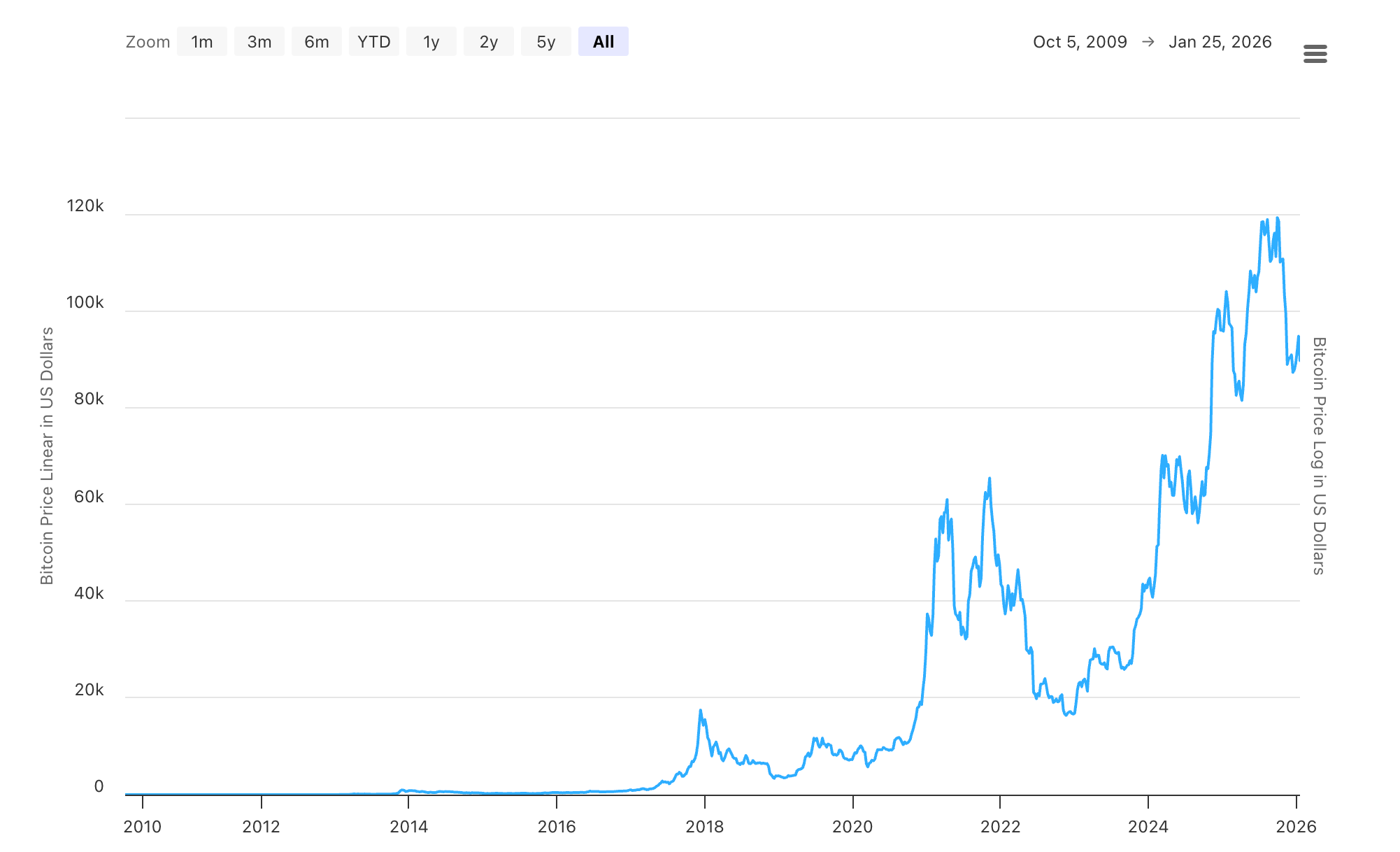
Bitcoin’s price history reveals recurring boom-and-bust cycles shaped by halvings, liquidity conditions, and investor sentiment. Early BTC growth was driven by retail speculation, but recent cycles show increasing institutional participation. Despite sharp drawdowns after each bull run, Bitcoin has consistently recovered to establish new highs, reinforcing its long-term upward trajectory.
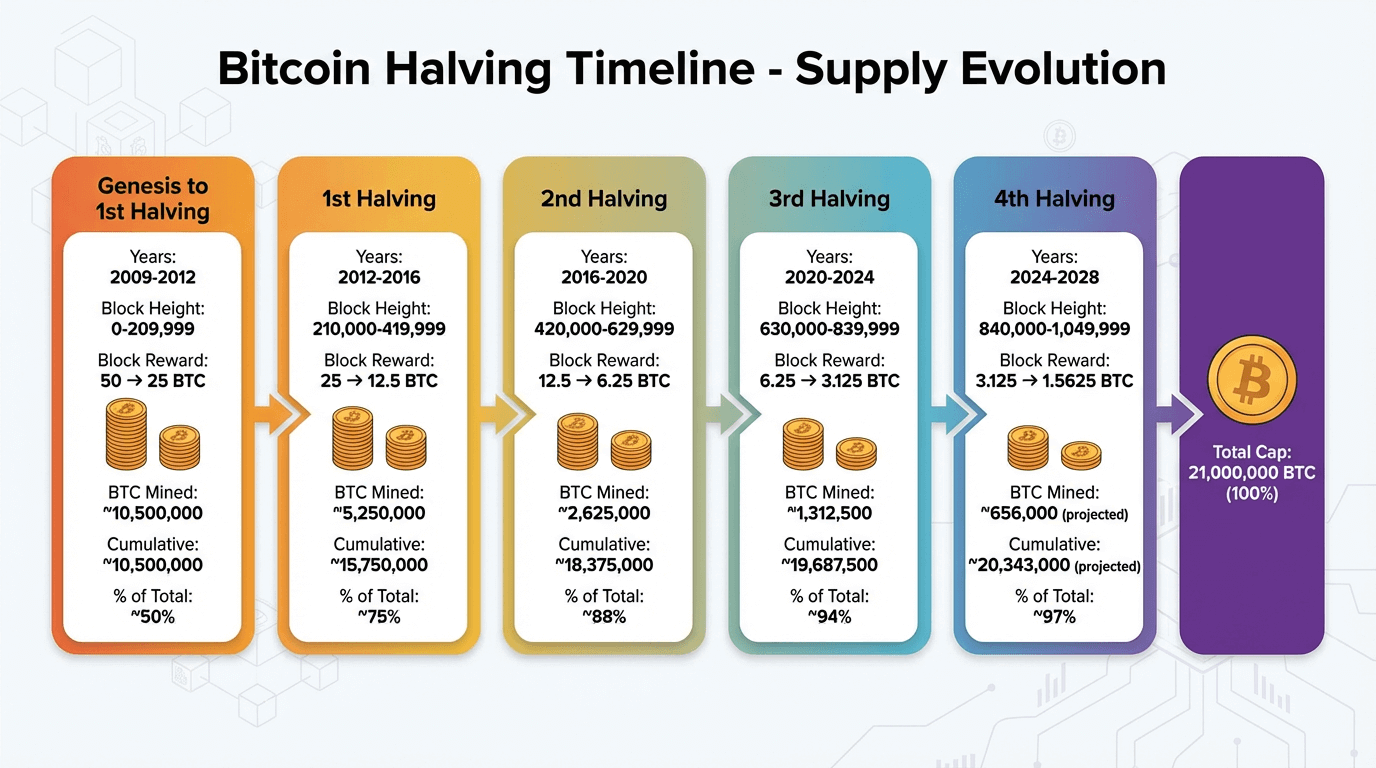
Halving events, which occur roughly every four years, reduce new BTC supply and have historically acted as catalysts for price surges. Understanding these cycles is crucial for interpreting the 2026–2030 BTC forecast scenarios.
Bitcoin All-Time Price Performance
Source: Bitbo.io
How Experts Forecast Bitcoin Prices
Analysts use several frameworks to project Bitcoin’s long-term price:
On-chain and cycle analysis examines halving cycles, issuance schedules, and realized price metrics to estimate future valuations.
Macro and liquidity models consider interest rates, inflation, and global money supply, often comparing Bitcoin to gold as a “hard money” asset.
Adoption and addressable-market models forecast Bitcoin’s potential share of institutional portfolios, corporate treasuries, and nation-state reserves, as exemplified by ARK Invest’s approach.
Longer-term forecasts (2030–2040) carry significant uncertainty due to regulatory, technological, and macroeconomic evolution.
Bitcoin Price Prediction 2026: Post-Halving Rally and ETF Impact
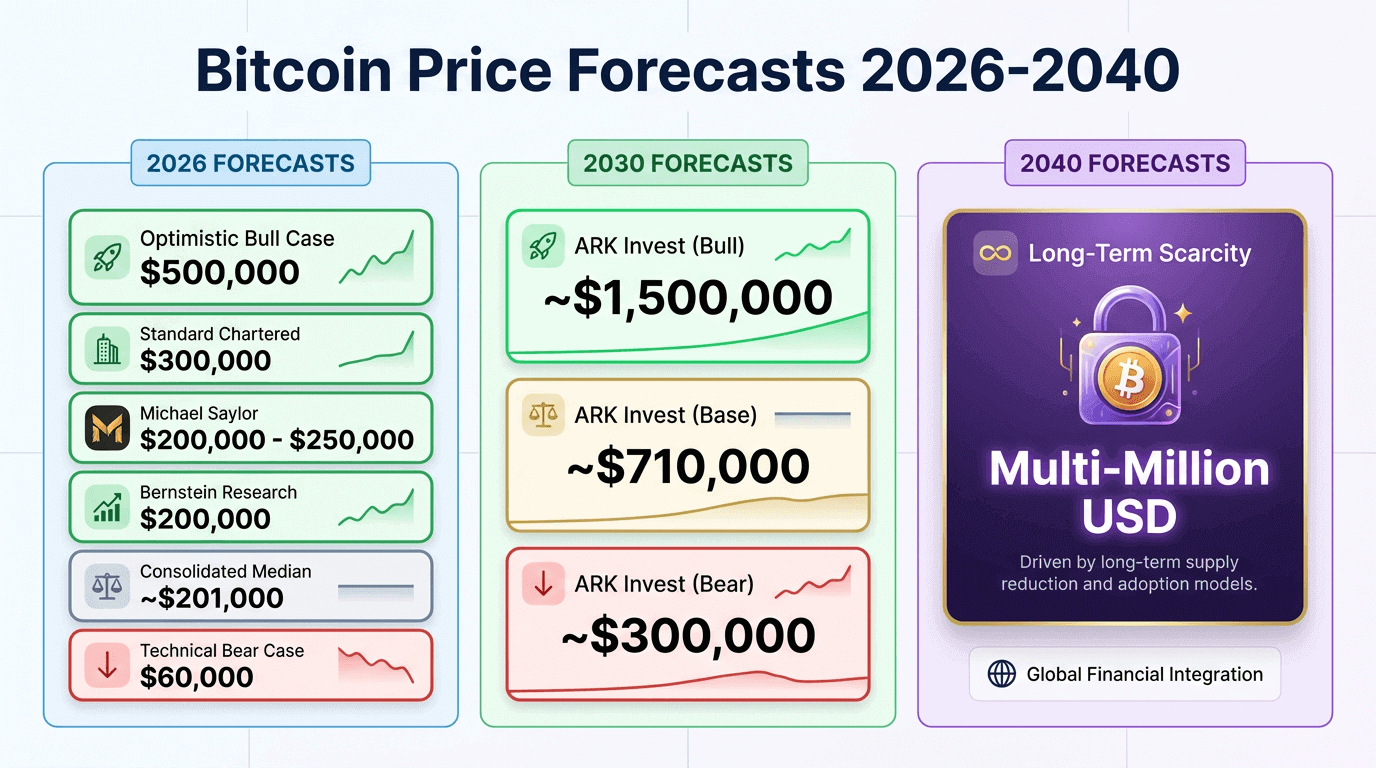
The 2026 BTC forecast reflects post-2024 halving dynamics, institutional inflows, and the potential effects of ETFs. Analysts project a wide range of outcomes, from conservative to bullish scenarios. Median third-party predictions suggest BTC could reach approximately $201,000, though bearish models indicate possible support floors near $60,000, and highly optimistic cases extend to $500,000.
Forecaster | Target | Timeframe for the price could vary, but analysts suggest 2025-2026 as significant for bitcoin. | Primary Drivers |
|---|---|---|---|
Standard Chartered | $300,000 | End-2026 | ETF inflows, policy tailwinds |
Bernstein Research | $200,000 | Early 2026 | Institutional integration and ETF AUM growth are crucial for the future of bitcoin. |
Michael Saylor | $200,000–$250,000 | By 2026 | Supply scarcity, corporate treasury adoption |
Technical bear case | $60,000 | 2026 drawdown floor | Cycle timing, pattern risk |
Key Drivers Shaping 2026 Forecasts
ETF and Institutional Flows
Spot Bitcoin ETFs have attracted over $150 billion in assets, with cumulative inflows projected to surpass $400 billion by 2026. These inflows support price appreciation by increasing demand among institutional investors.
Post-Halving Supply Dynamics
The 2024 halving reduced block rewards to 1.5625 BTC per block, constraining new supply and often prompting accumulation in the years before the next halving in 2028.
Regulatory Environment
Legislation such as the U.S. Digital Asset Market CLARITY Act and state-level initiatives could provide favorable conditions for Bitcoin adoption and ETF growth.
Market Sentiment and Cycle Timing
Historical patterns suggest late-stage bull runs peak 18–24 months after a halving, making 2025–2026 a critical accumulation period.
Bitcoin Price Prediction 2030: The Digital Gold Thesis
The 2030 BTC forecast emphasizes Bitcoin’s role as a digital store of value. Long-term models examine potential institutional adoption and the market’s acceptance of Bitcoin as “digital gold.”
According to ARK Invest’s Big Ideas 2025 report:
Bear Case (~$300,000): 1% institutional penetration, 20% digital gold market share.
Base Case (~$710,000): 2.5% institutional penetration, 40% digital gold market share.
Bull Case (~$1.5 million): 6.5% institutional penetration, 60% digital gold market share.
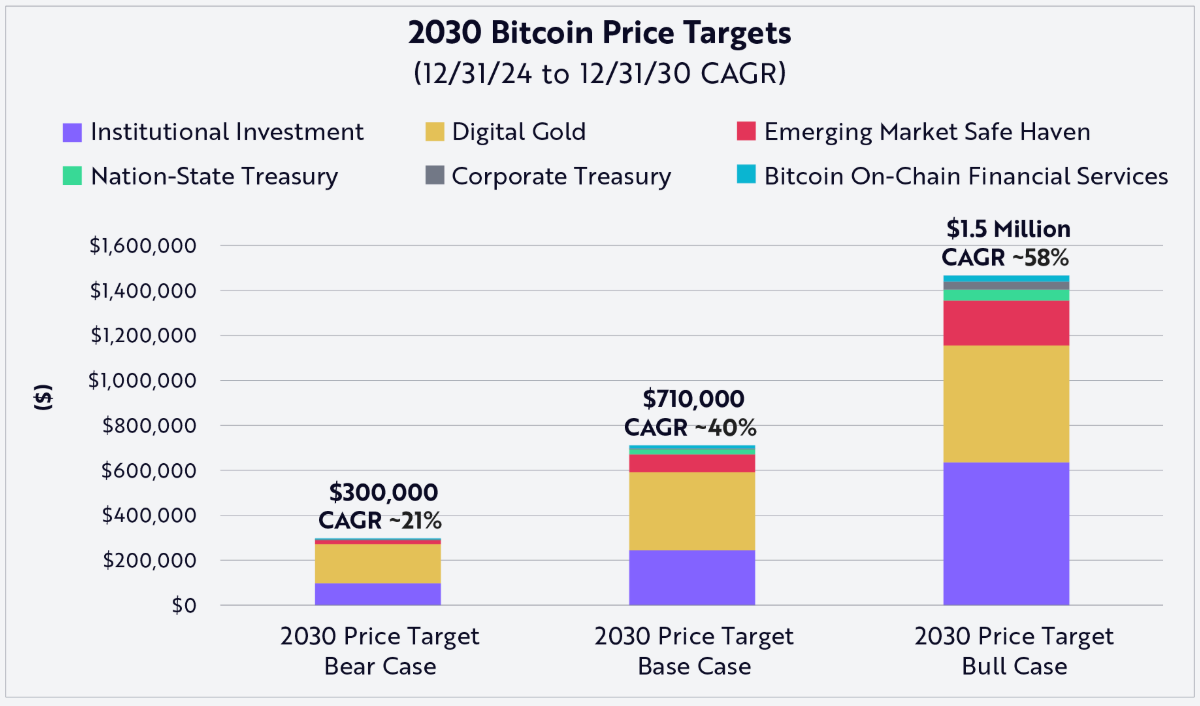
Source: ARK’s Price Target For Bitcoin In 2030
Small changes in these assumptions—such as institutional uptake or gold market capture—can significantly affect the 2030 BTC forecast.
Adoption, Use Cases, and Macro Assumptions to 2030
ARK's model identifies six potential contributors to capital accrual:
Institutional investment: Penetration of the global market portfolio (excluding gold) at 1%–6.5%.
Digital gold: Bitcoin capturing 20%–60% of gold's current ~$18 trillion market cap.
Emerging market safe haven: Allocation from the monetary base of developing nations.
Nation-state treasuries: Following the US executive order on a strategic Bitcoin reserve, other countries may follow.
Corporate treasuries: Inspired by MicroStrategy, more companies may diversify fiat cash with Bitcoin.
On-chain financial services: Layer 2s, Lightning Network, and wrapped BTC driving additional demand.
Modest changes in these assumptions can lead to very different 2030 outcomes, reinforcing the uncertainty of precise targets.
Bitcoin Price Forecast 2040: Scarcity and Long-Term Value
Why 2040 Projections Are Highly Speculative
Only a small subset of studies extend to 2040 or beyond. These typically use stylised models that extrapolate long-term trends in adoption and money supply. Some models project "multi-million-dollar" price points, but even their authors acknowledge the limitations of such extrapolations.
Structural Factors Shaping 2040 Scenarios
Fixed supply: Bitcoin's issuance schedule means new supply will approach near-zero by 2040, with total supply capped at 21 million.
Global monetary evolution: The development of CBDCs, stablecoin regulation, and broader digital asset adoption will shape Bitcoin's role.
Technological change: Scaling solutions, security improvements, and competition from other protocols may affect Bitcoin's market position.
By 2040, regulatory, technological, and macroeconomic paths may look very different from today, so these scenarios should be seen as conceptual rather than precise forecasts.
Key Risks and Uncertainties Across 2026-2030-2040
Analysts frequently highlight the following cross-cutting risk themes:
Regulatory tightening: Potential bans or restrictive policies in major markets could limit adoption.
Macro and liquidity shocks: Events affecting all risk assets—such as recessions or credit tightening—could trigger significant drawdowns.
Technology and competition: Protocol vulnerabilities or loss of market share to other digital assets remain ongoing concerns.
Forecast dispersion: The wide range of third-party forecasts underscores the importance of understanding model assumptions, not just headline numbers.
From Insight to Action with OSL
Given the volatility and risks outlined above, how should an investor proceed? The key lies in informed decision-making. This means looking beyond single price targets for 2026, 2030, or 2040, and instead focusing on the long-term scenarios and underlying drivers—such as institutional adoption and regulation—that will ultimately determine outcomes.
This prudent approach is best executed within a secure and supportive environment. For those ready to explore Bitcoin exposure, whether directly or through regulated products, choosing a licensed platform is a critical first step.
At OSL, we provide both the security and the incentives to begin your journey. As Asia's leading licensed digital asset platform, we offer you secure trading and custody services. Beyond our institutional-grade infrastructure, the OSL Task Center actively rewards your participation:
For new users: Receive $15 in BTC for signing up, completing KYC, and achieving a $100 trading volume.
For active traders: Earn up to $300 in BTC through challenges like the “January Trading Challenge”.
For community advocates: Get up to $165 in BTC for each successful referral with our “Invite & Earn” program.
Whether you’re taking your first steps or are an experienced participant, OSL is your regulated venue to act on your market analysis while turning activity into tangible rewards.
FAQs on Bitcoin Price Predictions
Q1: What is the most accurate Bitcoin price prediction for 2030?
There is no single prediction; most models suggest BTC could range from $200,000 to $700,000, based on gold market capture and institutional adoption.
Q2: Can Bitcoin reach $1 million by 2040?
Yes, in bullish scenarios, with strong institutional and sovereign adoption, though base-case forecasts remain more conservative.
Q3: What factors will influence BTC in 2026?
Post-2024 halving cycles, ETF inflows, and macro conditions will largely drive BTC’s 2026 price trajectory.
Q4: Why do Bitcoin price predictions vary?
Methodologies differ (on-chain vs. macro models), assumptions about adoption rates, regulation, and market conditions vary widely, creating a broad range of forecasts.
Start your safe cryptocurrency journey now
OSL | Secure Ramps. Trusted Rails !
More topics
More topics


Latest
Why India's $620B Bond Pilot Changed Nothing Legal
SEBI and the RBI's Demat 2.0 pilot issues corporate bonds as digital tokens and settles them with the wholesale digital rupee, preserving existing legal terms while digitizing the infrastructure beneath a $620...
Why India's $620B Bond Pilot Changed Nothing Legal
Why S&P Global Leads Kaiko: Not Hype, But 24/7 Market Infrastructure
S&P Global led a $110 million extension of Kaiko's Series B to build data infrastructure for round-the-clock tokenized markets.
Why S&P Global Leads Kaiko: Not Hype, But 24/7 Market Infrastructure
When One Firm Holds 5% of Ethereum: Infrastructure Stress Test
Bitmine's accumulation of more than 5 million staked ETH raises questions about whether custody, audit, and validator infrastructure can support single-asset concentration at public-company scale.
When One Firm Holds 5% of Ethereum: Infrastructure Stress Test
Best Enterprise Stablecoin Payment Providers: A 2026 Evaluation Framework
Compare enterprise stablecoin payment providers by use case, legal entity, workflow, controls, integration, reconciliation, support, and contract terms.
Best Enterprise Stablecoin Payment Providers: A 2026 Evaluation Framework
How to Reconcile a USDGO Payment: An Illustrative Finance-Close Example
See how Finance can trace a USDGO payment from an approved obligation through payment records, recipient confirmation, reconciliation, and accounting close.
How to Reconcile a USDGO Payment: An Illustrative Finance-Close Example
A USDGO Reserve Review in Practice: Findings, Limits and Follow-up Questions
Review what the July 2026 USDGO reserve attestation establishes, what it does not prove, and which issuer, redemption, and liquidity questions remain.
A USDGO Reserve Review in Practice: Findings, Limits and Follow-up Questions
Recommended for you
More topics
More topics
