Will Dogecoin Reach $10? Market Analysis and Tokenomics

Dogecoin (DOGE) is one of the original and most widely recognized meme‑inspired cryptocurrencies, launched in 2013 as a lighthearted alternative to Bitcoin. Over the years, it has attracted significant community interest and retail trading activity. As of Jan 2026, DOGE trades at approximately $0.15–$0.16 with a market capitalization in the tens of billions of dollars.
Given its popularity and historical price spikes, a common question among observers and participants is: will Dogecoin reach $10? This article provides an objective analysis of relevant factors, including current price dynamics, tokenomics, and third‑party perspectives, without making specific price or investment recommendations.
What is Dogecoin?
Dogecoin began as a meme coin but has since maintained a notable presence in the broader cryptocurrency landscape. It operates on a proof‑of‑work blockchain similar to Litecoin, with a key distinction: there is no maximum supply cap. Instead, a set number of DOGE is issued each minute via mining, which leads to a continually increasing circulating supply.
DOGE’s use cases typically revolve around micro‑transactions, tipping, and community‑driven payment activity, rather than complex decentralized finance (DeFi) features or smart contract functionality. Its price history has shown strong correlation with sentiment and speculative interest, rather than structural utility growth.
Current Market Overview
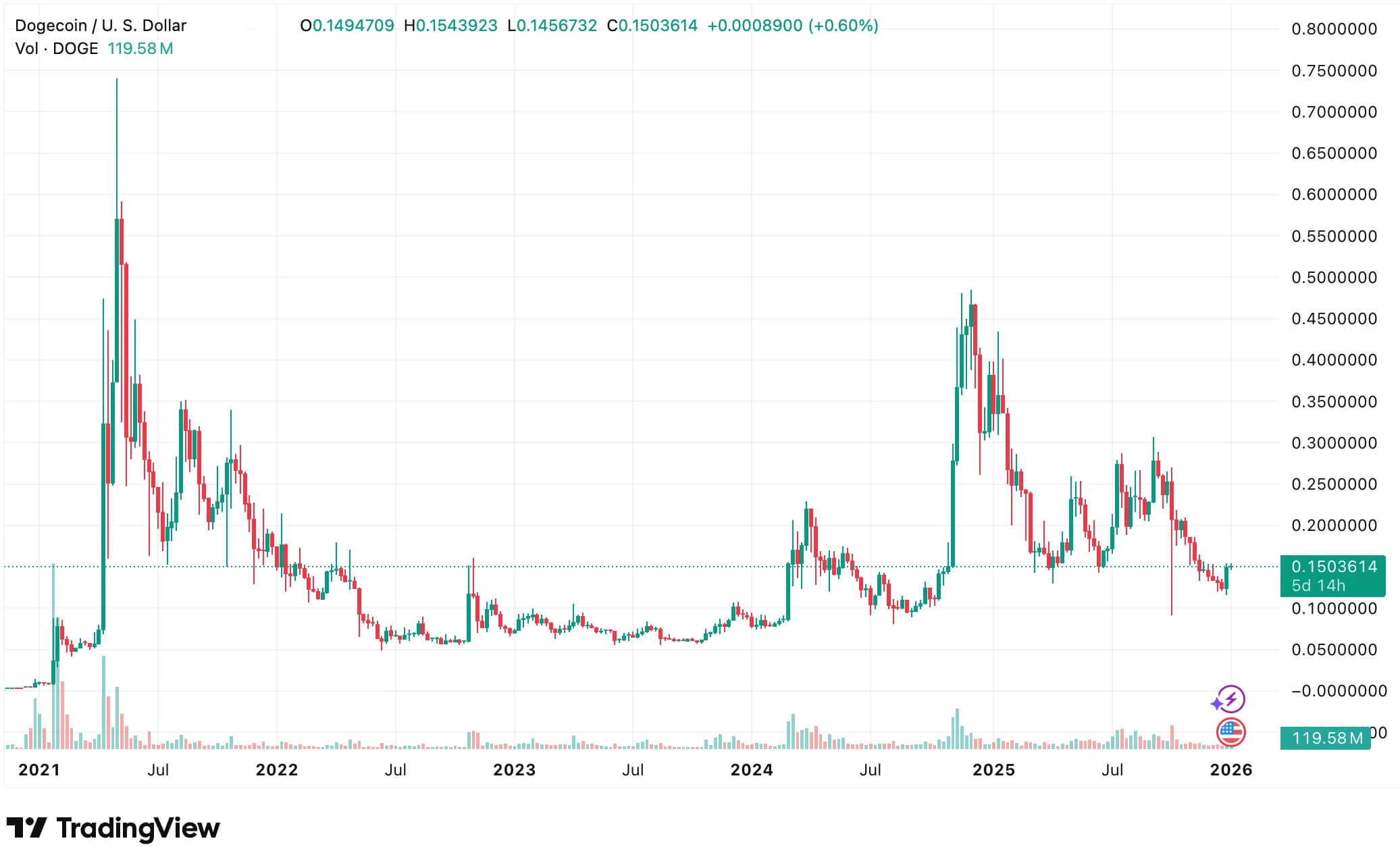
As of the most recent data, Dogecoin’s price sits near $0.15–$0.16 with a circulating supply around 167.9 billion tokens.
DOGE’s all‑time high was approximately $0.7316, achieved during the 2021 crypto boom — a level well above its current pricing but still far from double‑digit territory.
Recent forecasts from algorithmic and expert‑driven sources show varied near‑term expectations — for example, some models project moderately higher prices in the range of $0.30–$0.70 by 2026 under certain conditions, while others show relatively flat growth scenarios.
Tokenomics and Supply Implications
Metric | Value |
|---|---|
Circulating Supply | ~167.9 B DOGE |
Max Supply | No cap (infinite issuance) |
Latest Price | ~$0.13–$0.14 |
All‑Time High | ~$0.7316 |
For DOGE to reach $10 per token, its market capitalization would need to exceed approximately $1.4 trillion, assuming the circulating supply remains similar to current levels.
This implied market cap would place DOGE on par with or above major global financial assets and far beyond the market capitalizations of most cryptocurrencies today — including tokens with broader utility ecosystems.
The inflationary nature of DOGE, where new coins are continuously mined and added to circulation, adds another structural challenge to sustained upward price pressure.
Third‑Party Perspectives and Forecasts
Third‑party forecasts on DOGE’s future price vary significantly and generally do not support a near‑term path to $10.
Some analysts such as Cryptomus suggest that moderate gains remain possible, with DOGE potentially reaching multi‑figure cents or single‑dollar price bands in optimistic long‑term scenarios.
Others such as AInvest emphasize that achieving $10 would require “extraordinary factors” and market growth far beyond current conditions, likely making such a target unrealistic under typical forecasting assumptions.
Algorithmic forecast models such as published by CoinCodex have indicated that DOGE would need a >7,000 % price increase to hit $10, a scenario their data does not support, with some predicting sub‑dollar peaks even decades ahead.
While speculative social commentary sometimes suggests dramatic outcomes, mainstream market forecasts like Coinspeaker are cautious — and most anchor DOGE prices well below the $10 threshold in their projections.
Factors That Could Influence Future Price Trajectory
Several factors might influence DOGE’s price direction, though none inherently guarantee a path to $10:
Market Adoption & Utility: Increased real‑world usage, for payments or micro‑transactions, could support demand, but such adoption has historically been limited.
Sentiment & Speculation: Meme coins often derive price momentum from community interest and retail speculation rather than fundamental utility.
ETF and Institutional Products: The introduction of dedicated products like the DOJE Dogecoin ETF may broaden market access and visibility, potentially affecting liquidity dynamics.
Macro Factors: Broader crypto market cycles and risk sentiment often drive meme coin pricing.
Token Supply Expansion: DOGE’s infinite supply structure presents a structural headwind for sustained unit price increases.
These factors may contribute to price fluctuations and trend shifts, but they do not inherently mitigate the substantial market cap gap required for a $10 price.These scenarios help contextualize price discussions alongside the scale of capital that would be required for each outcome.
Conclusion and Outlook
An objective review of Dogecoin’s current pricing data, tokenomics, and broader market forecasts suggests that a $10 price per DOGE is highly ambitious under existing structural conditions. The market capitalization needed for that valuation is extraordinarily large relative to DOGE’s current scale and even most other crypto assets.
While DOGE remains one of the most visible and culturally prominent meme coins, forecasting models and market analyses generally place its potential outcomes well below the $10 threshold in realistic scenarios. Instead, it can be more informative to assess DOGE’s future within a range of outcomes that reflect both demand drivers and structural supply characteristics.
Start your safe cryptocurrency journey now
OSL | Secure Ramps. Trusted Rails !
More topics
More topics


Latest
Stablecoin Weekly Pulse | Vol. 22: Welcome to the “Trump Resort”
Even once the rules are set, who really wins? When the high rollers cash out, will they tip off whoever’s left at the table that it’s time to go too?

Stablecoin Weekly Pulse | Vol. 22: Welcome to the “Trump Resort”
From Bank Killer to Bank Builder: Kraken's Strange Turn
Payward, the parent company of crypto exchange Kraken, is exploring how to become a "full bank" outside the United States.
From Bank Killer to Bank Builder: Kraken's Strange Turn
Stablecoin Weekly Pulse | Vol. 21: Tokenized Deposits vs Stablecoins
As tokenized deposits and stablecoins converge, the battle over financial infrastructure intensifies — each side sees the other's missing piece, but neither will surrender its core moat.

Stablecoin Weekly Pulse | Vol. 21: Tokenized Deposits vs Stablecoins
Stablecoin Weekly Pulse | Vol. 20: The Stablecoin Express: Next Stop, Card
Stablecoins aren’t just an issuance game — the real battle is over infrastructure, channel capital, and users.

Stablecoin Weekly Pulse | Vol. 20: The Stablecoin Express: Next Stop, Card
Stablecoin Weekly Pulse | Vol. 19: The Market Potential for Compliant, Enterprise-Grade Stablecoins
Stablecoin activity cooled while firms kept investing. Vol. 19 examines regulation and enterprise demand across emerging-market payment corridors.

Stablecoin Weekly Pulse | Vol. 19: The Market Potential for Compliant, Enterprise-Grade Stablecoins

Recommended for you
More topics
More topics
