What is the XRP Rich List in 2026? Understanding Token Distribution and Whale Rankings
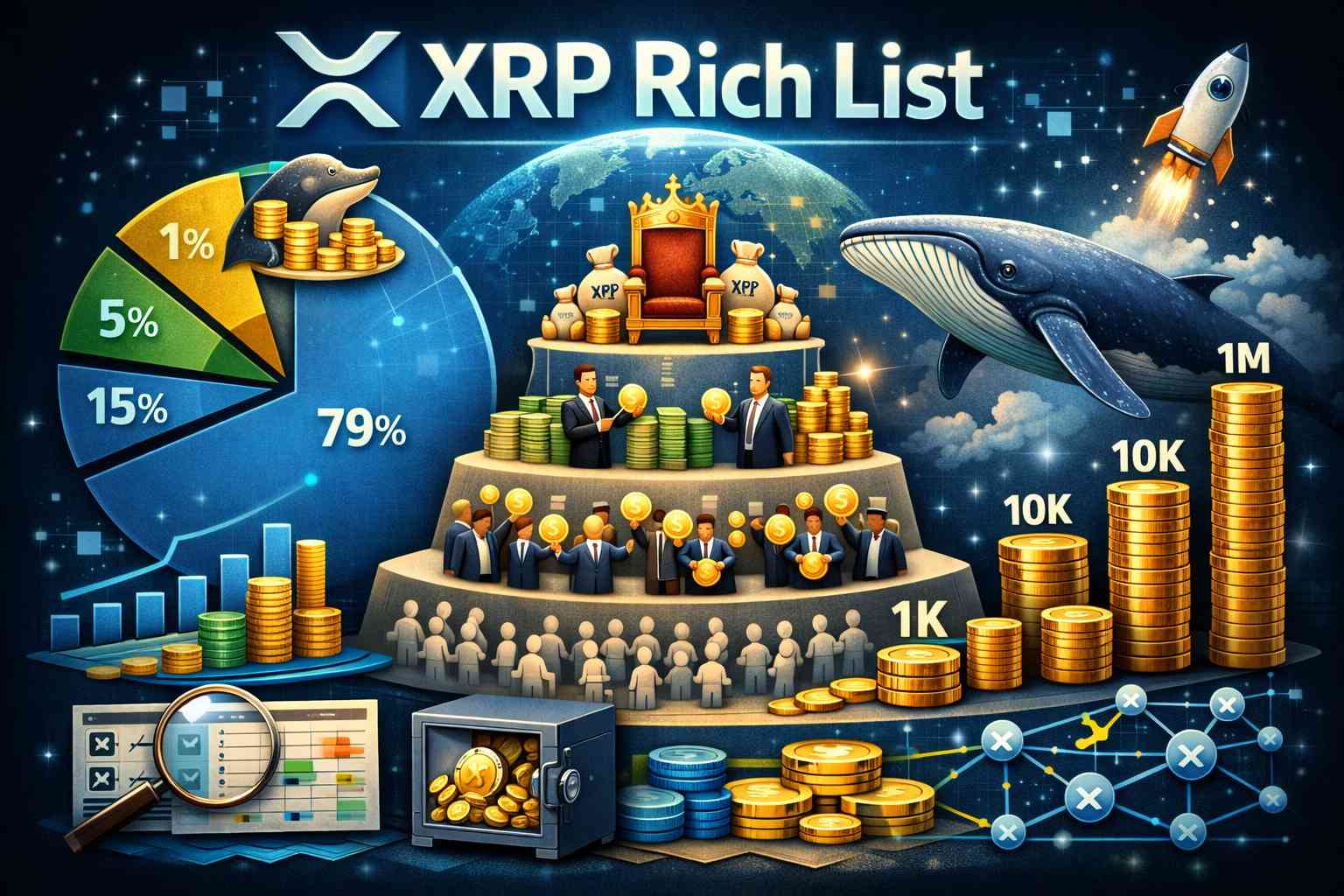
If you’ve recently entered the world of cryptocurrency, you may have come across the term “XRP Rich List.” At first glance, it might sound mysterious or even exclusive. Still, the concept is actually quite simple,and very useful for understanding how XRP, the native token of the XRP Ledger, is distributed across different wallets.A rich list is a ranking of wallets based on how much of a particular cryptocurrency they hold. For XRP, the rich list gives anyone a transparent view of how XRP ownership is spread between regular users, exchanges, long-term holders, and major entities like Ripple Labs. This type of information helps beginners understand how decentralized a token is, how wealth is distributed, and how big holders,often called “whales”, might impact market behavior.Below, we break down what the XRP Rich List is, how it's compiled, what it reveals about the XRP ecosystem, and how many XRP people typically hold. We’ll also answer common beginner questions and explain why these lists matter, even if you’re not a large XRP holder yourself.
What is the XRP Rich List?
2026 refresh: methodology and interpretation limits
Rich-list data ranks wallet addresses, not verified individuals. Exchange wallets, custody wallets, and multi-wallet users can distort the view, so the data is best used as a distribution signal rather than a personal wealth ranking.
Signal | Useful for | Limit |
|---|---|---|
Wallet threshold | Understanding approximate percentile bands. | Wallets are not the same as people. |
Exchange wallets | Explaining unusually large balances. | May represent pooled customer assets. |
Snapshot date | Keeping the estimate tied to a market moment. | Thresholds can move as balances change. |
Related reading: XRP Rich List distribution and whale rankings
FAQ: rich-list data
Can rich-list data predict price?
Not by itself. Holder concentration is one market-structure signal, but price depends on liquidity, demand, macro conditions, and regulatory context.
Definition in Simple Terms
The XRP Rich List is a public ranking of XRP wallet addresses based on how much XRP they contain. Since the XRP Ledger is a public blockchain, anyone can view wallet balances. This allows platforms to compile these balances into ranked lists that show how ownership is distributed across millions of addresses.
How the XRP Rich List is Created
Rich-list platforms gather information directly from the XRP Ledger. Every time the ledger updates, the rankings also update. Popular sources such as XRPSCAN and Rich-List.info collect and organize this data, grouping wallet addresses into categories depending on how much XRP they hold. While the list shows wallet addresses, it does not reveal personal identity unless the address is publicly known,such as an exchange wallet.
Why Tracking the Rich List is Useful
For beginners, rich lists help answer questions like:
Is most of the supply concentrated in a few wallets?
How much do typical holders own?
Are big holders increasing or reducing their positions?
These insights help understand supply distribution, community participation, and how large movements of XRP might affect sentiment.
Understanding XRP Ownership Distribution
Total XRP Supply and Wallet Count
XRP has a fixed supply of 100 billion tokens, with a large portion originally allocated to Ripple Labs. Over time, XRP has been distributed among millions of wallets. As of March 2026, the XRP Ledger has surpassed 7.85 million activated addresses, a dramatic increase from the 4.5 million range recorded in 2023. When reconciling on-chain wallet data with off-chain exchange users across centralised platforms, the total number of unique XRP owners globally is estimated between 18 million and 25 million. Rich-list platforms often show not just the top wallets but also the total number of active addresses, how many wallets hold small balances, and how many hold more significant amounts.
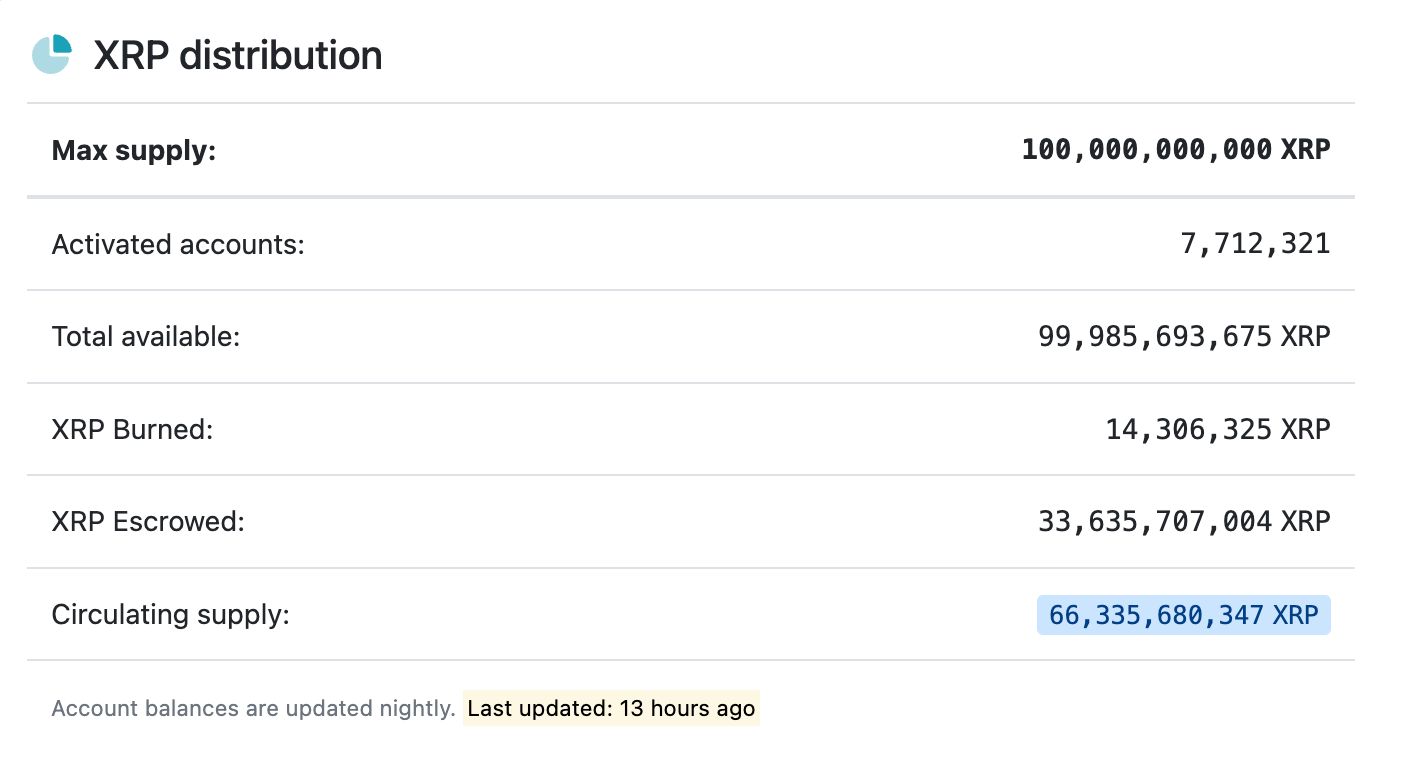
Source: xrpscan as at March 19th, 2026
How Concentrated Is XRP Wealth?
Like many cryptocurrencies, XRP is somewhat top-heavy. A relatively small number of wallets control a large portion of the supply. However, many of these large addresses belong to centralized exchanges that hold XRP on behalf of their users. This is important because a single exchange wallet may represent thousands, or even millions, of individual users.
Major Categories of XRP Holders
Ripple Labs: Ripple holds a large supply of XRP, some of which is locked in escrow and released on a scheduled basis. These holdings are widely known and publicly tracked.
Centralized Exchanges: Wallets belonging to leading exchanges appear as some of the largest XRP holders because they store customer deposits.
Long-Term Holders (“Whales”): Early adopters and individual large holders also appear in the upper tiers of the list.
Everyday Users: Millions of smaller wallets form the base of the distribution chart.
Who are the Top XRP Holders?
While individual identities are mostly unknown, categories are well understood.
Ripple and Escrow Holdings
Ripple originally received a significant amount of XRP at the creation of the XRP Ledger. Much of this XRP is kept in escrow accounts and released periodically. These escrow wallets show up as some of the largest addresses on the rich list.
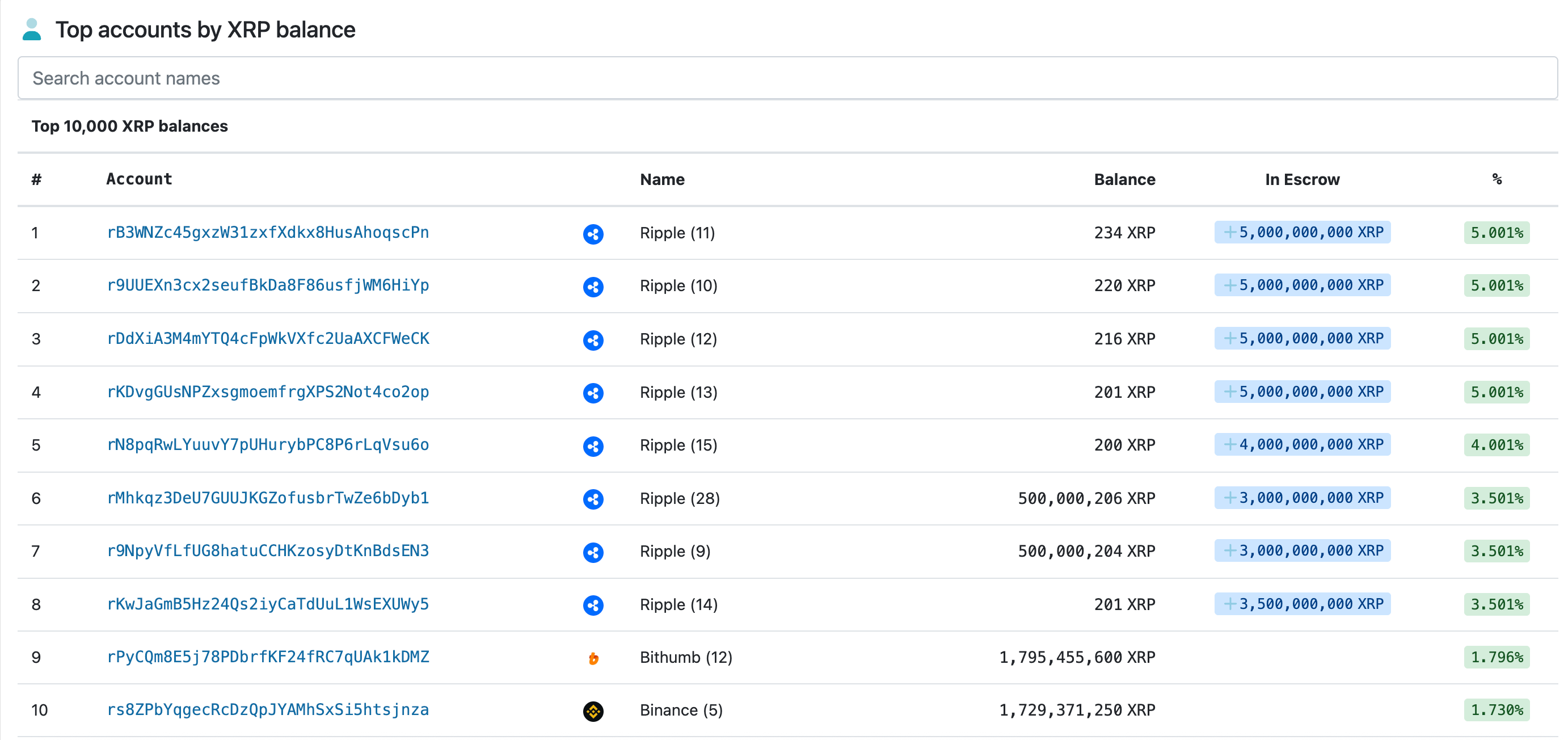
Source: xrpscan as at March 19th, 2026
Exchanges on the XRP Rich List
Exchanges such as Binance and others hold XRP on behalf of users. Their wallets usually contain millions or even billions of XRP, placing them high on the list. However, these balances do not represent the holdings of a single person or entity.
Individual Whales and Early Supporters
Some large wallets consist of long-time holders who accumulated XRP in the early years. These wallets influence the rich list rankings and, in some cases, attract community interest. However, their activity is publicly visible, which means the market can observe patterns without knowing personal details.
2025–2026: A Turning Point for XRP Ownership
The composition of the XRP Rich List has shifted meaningfully following two landmark events. In August 2025, the U.S. Securities and Exchange Commission formally concluded its lawsuit against Ripple Labs, with Ripple paying a $125 million settlement. This resolution confirmed that XRP is not classified as a security when sold on public exchanges, removing a multi-year cloud of regulatory uncertainty that had suppressed institutional participation.Shortly thereafter, in November 2025, the first spot XRP Exchange-Traded Funds (ETFs) received regulatory approval in North America. These products allowed traditional brokerage users to gain XRP exposure without managing private keys. The impact was immediate: ETF inflows reached $1.3 billion within weeks of launch, and institutional names such as Goldman Sachs emerged among the top holders of these new instruments. The top 30 institutional ETF holders collectively held $211 million worth of XRP ETF positions by end of 2025. This institutional "on-ramp" has fundamentally changed who appears at the upper tiers of the XRP Rich List.
How Much XRP Makes You “Rich”?
This is one of the most common questions beginners ask, and the rich list provides a data-driven way to answer it.
Entry Levels on the XRP Rich List
Rich-list data often shows thresholds such as:
How much XRP you need to be in the top 10% of holders
How much is required to be in the top 5% or top 1%
As of early March 2026, the XRP Ledger's verified data provides precise benchmarks for each tier of the wealth distribution. Holding approximately 2,350 XRP is sufficient to rank in the top 10% of all XRP holders globally. Moving into the elite tier requires considerably more: the top 1% threshold currently stands at roughly 46,323 XRP, while reaching the top 0.5% demands approximately 83,082 XRP. The most exclusive tier—the top 0.01%—commands holdings exceeding 3.83 million XRP, a bracket occupied almost exclusively by exchanges, institutional custodians, and Ripple's own operational wallets. Despite the network growing by 30% in wallet count since 2024, these thresholds have remained relatively stable, indicating that accumulating a meaningful position remains achievable for dedicated retail participants.
What Most People Actually Hold
Most XRP wallets hold relatively small amounts, often below 100 XRP. This means new users do not need a large balance to surpass the majority of holders. The distribution also shows steady growth in the number of mid-sized wallets, often considered a sign of broadening participation.
How This Has Changed Over Time
Thresholds have gradually increased as XRP ownership spreads. More users entering the ecosystem means that being in the top percentages requires slightly more XRP than in years past. These trends reflect network growth and user adoption.
Common Questions About the XRP Rich List
What is the XRP Rich List?
In simple terms, it is a ranked list of wallet addresses sorted by XRP balance. It allows anyone to see how XRP is distributed across the network.
How Many XRP Do You Need to Be “Rich”?
There is no official definition of “rich,” but the rich list provides numerical thresholds. Some users define richness by being in the top percentiles of holders, while others define it based on long-term goals. The rich list focuses on distribution,not wealth targets,so interpretations vary.
How Many People Own 5000 XRP?
Because 5,000 XRP is above the median wallet balance, only a relatively small percentage of wallets hold more than this amount. Rich-list platforms typically display how many wallets fall into each balance range, making this easy to estimate.
Is XRP Going to Make Millionaires?
This is a popular yet speculative question. Rich lists do not predict future prices and should not be used as investment forecasting tools. They simply show how XRP is distributed today. Whether any asset could reach specific price targets depends on market adoption, utility, and broader economic factors.
Risks and Considerations When Using the Rich List
Wealth Concentration and Market Impact
Large wallets can influence perception. If whales increase or reduce their holdings, it may spark discussions, even if the movements come from exchanges or internal transfers rather than individual decisions.
Exchanges vs Personal Wallets
Rich lists do not immediately distinguish between a personal wallet and an exchange wallet unless the address is tagged. Exchange wallets often hold pooled funds belonging to many users, so they may appear larger than they actually are in terms of individual ownership.
Why Rich Lists Are Not Investment Advice
A rich list reveals distribution, not price direction. While it helps users understand how a token is held across the network, it should not be interpreted as a signal for financial action.
How to View the XRP Rich List Yourself
Tools and Platforms
You can explore XRP distribution using:
XRPSCAN – a blockchain explorer for checking balances and transactions
Rich-List.info – a dashboard showing distribution tiers
Other XRP Ledger explorers that provide rankings and charts
These tools make it easy for beginners to see wallet rankings in real time.
Interpreting What You See
When viewing a rich list:
Tagged wallets, for example, “Binance”, indicate exchange holdings
Large unlabeled wallets may belong to institutions or early holders
Escrow accounts often contain predictable, locked amounts
Understanding these categories helps avoid misinterpreting the data.
Final Thoughts
The XRP Rich List offers a clear window into how XRP is distributed across the network, making it easier for beginners to understand the roles of whales, exchanges, and everyday holders. By seeing how supply is spread, new users can better appreciate the transparency of blockchain systems and how different types of wallets contribute to the health and activity of the XRP ecosystem.
As the XRP Ledger continues to grow, the rich list remains a valuable tool for observing trends, monitoring distribution patterns, and learning how digital asset networks evolve. While it cannot predict future prices or guarantee outcomes, it helps users build a more informed understanding of the broader XRP landscape.
For those who want practical exposure to XRP, accessing this asset through a regulated channel has never been more straightforward. OSL, a publicly listed company on the Hong Kong Stock Exchange (HKEX: 863) and holder of a Type 1 and Type 7 licence from the Securities and Futures Commission (SFC), officially listed XRP for Professional Investors in December 2025, XRP/HKD, XRP/USD, XRP/USDT (Now Live). With XRP now available on OSL HK, users can seamlessly access and flash trade XRP within one of Asia’s most compliant, institution-grade digital asset environments. Eligible users can utilize the fully compliant fiat on-ramp to deposit HKD or USD and execute trades with ease.
Furthermore, OSL Global provides a comprehensive suite of trading options for international users. You can engage in spot trading through our deep-liquidity order books for XRP/USD and XRP/USDT. If you prefer instant execution with zero trading fees, our Flash Trade feature allows you to convert USDT directly to XRP with just a few clicks, offering one of the most efficient and institution-grade entry points for XRP in the market.
More topics
More topics


Latest
Why India's $620B Bond Pilot Changed Nothing Legal
SEBI and the RBI's Demat 2.0 pilot issues corporate bonds as digital tokens and settles them with the wholesale digital rupee, preserving existing legal terms while digitizing the infrastructure beneath a $620...
Why India's $620B Bond Pilot Changed Nothing Legal
Why S&P Global Leads Kaiko: Not Hype, But 24/7 Market Infrastructure
S&P Global led a $110 million extension of Kaiko's Series B to build data infrastructure for round-the-clock tokenized markets.
Why S&P Global Leads Kaiko: Not Hype, But 24/7 Market Infrastructure
When One Firm Holds 5% of Ethereum: Infrastructure Stress Test
Bitmine's accumulation of more than 5 million staked ETH raises questions about whether custody, audit, and validator infrastructure can support single-asset concentration at public-company scale.
When One Firm Holds 5% of Ethereum: Infrastructure Stress Test
Best Enterprise Stablecoin Payment Providers: A 2026 Evaluation Framework
Compare enterprise stablecoin payment providers by use case, legal entity, workflow, controls, integration, reconciliation, support, and contract terms.
Best Enterprise Stablecoin Payment Providers: A 2026 Evaluation Framework
How to Reconcile a USDGO Payment: An Illustrative Finance-Close Example
See how Finance can trace a USDGO payment from an approved obligation through payment records, recipient confirmation, reconciliation, and accounting close.
How to Reconcile a USDGO Payment: An Illustrative Finance-Close Example
A USDGO Reserve Review in Practice: Findings, Limits and Follow-up Questions
Review what the July 2026 USDGO reserve attestation establishes, what it does not prove, and which issuer, redemption, and liquidity questions remain.
A USDGO Reserve Review in Practice: Findings, Limits and Follow-up Questions
Recommended for you
More topics
More topics
