A Practical Guide to DEXs for Beginners: Your Step-by-Step First Decentralized Trade
If you're used to clicking 'Buy' or 'Sell' on centralized platforms like you're online shopping, your first encounter with a Decentralized Exchange (DEX) might feel like stepping into a maze of code and unfamiliar terms. There's no customer service, no password recovery, and every operation happens on-chain.
But this is precisely the charm of the Web3 world. Imagine you no longer need to deposit your money in a 'bank' (a centralized exchange). Instead, you engage in peer-to-peer value exchange directly with market participants worldwide. Today, we will say goodbye to intermediaries with a step-by-step guide to your first Decentralized Exchange (DEX) experience, breaking down each step to help you move forward safely and confidently.
Why You Need to Leave Your Comfort Zone: The Core Differences Between DEXs and Traditional Exchanges
You might ask, 'I'm trading just fine on my traditional app, why bother with a DEX?'
The core reason is 'asset control.' On a traditional Centralized Exchange (CEX), your assets are actually held in custody by the platform. It's like putting your money in a bank; if the bank fails, you might not get your money back. On a DEX, your assets remain in your wallet until the very moment a trade occurs.
We can use a simple analogy to understand this:
Traditional Exchange (CEX): Think of it as the 'Amazon Marketplace.' Merchants send their goods to an Amazon warehouse, and you buy from Amazon. Amazon is responsible for storing the goods and processing the funds. If the Amazon warehouse shuts down, your goods and money are locked inside.
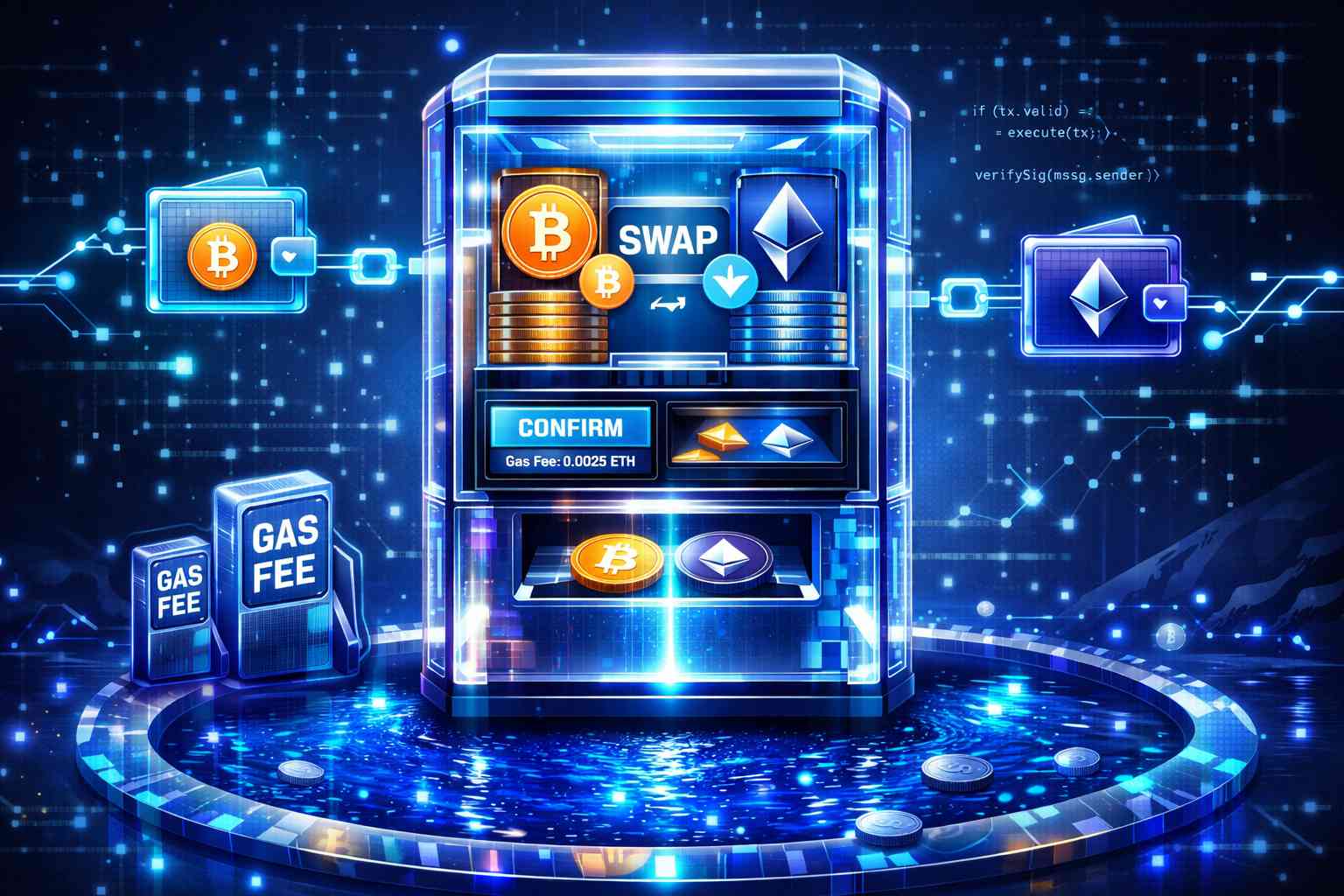
Decentralized Exchange (DEX): This is like a fully automated 'vending machine.' There's no salesperson, no owner. You insert Token A, and a smart contract (automated code) instantly dispenses Token B to you based on the current exchange rate.
According to 2025 industry data, DEX trading volume has, at certain times, accounted for a significant portion of the entire cryptocurrency spot trading market, indicating that more and more users are prioritizing self-custody of their assets. DEXs use smart contracts to execute trades automatically, eliminating the need to trust an intermediary and achieving a state where 'code is law.'
Your Pre-Entry Toolkit: Understanding Web3 Wallet Setup and the Gas Fee Mechanism
Before entering a DEX, you first need a 'key'—a Web3 wallet (a non-custodial wallet).
This is like needing a local 'digital wallet' to buy things at an overseas market; you can't just use your domestic bank card. This wallet not only stores your funds but also serves as your 'universal ID' in the Web3 world.
After connecting your wallet, the concept that most often confuses beginners is the 'Gas Fee' (miner fee/network fee).
What is a Gas Fee? Imagine you're sending a package. You have to pay not only for the item but also a shipping fee to the courier company. On the blockchain, the Gas Fee is the 'shipping fee' paid to the 'bookkeepers' (miners or validators).
Who collects this fee? Please note, this fee is not collected by the DEX, but by the blockchain network. Whether the transaction succeeds or fails, you have to pay as long as the network has processed your data.
Key Tip Always keep a small amount of the native token (e.g., the blockchain's base currency) in your wallet for Gas fees. It's like keeping some fuel in your car. If you swap your entire balance for another token and leave nothing for 'fuel,' your wallet will be unable to initiate any transfers.
A Full Walkthrough: Step-by-Step Guide to Your First Swap Transaction
With the preparations done, let's move on to the core operation: the Swap. This is equivalent to exchanging 'USD' for 'EUR' at a bank, but on a DEX, it happens instantly.
Here is the standard procedure:
Connect Wallet Open the DEX interface and click 'Connect Wallet' in the top right corner. This is like logging into a website, but instead of a username and password, you authorize it with a signature from your wallet.
Select Token In the 'From' field, select the token you currently hold. In the 'To' field, select the token you want to receive.
Approve — A Necessary Step for Beginners If this is your first time trading a specific token, you'll notice the button says 'Approve' instead of 'Swap.'
Simple Explanation: This is like signing a check before handing it to the bank teller, authorizing them to 'access these funds.' For security, the smart contract must first get your permission to use that specific token.
Execute Swap After the approval is complete, click 'Swap.' Your wallet will pop up a confirmation window showing the estimated Gas fee. If everything looks correct, click to sign.
Wait for On-Chain Confirmation After a few seconds, you'll see 'Transaction Submitted.' Once confirmed on the chain, the new tokens will appear directly in your wallet balance.
Trading Like a Pro: Understanding Slippage Settings and Liquidity Depth
During the process, you might notice a setting called 'Slippage Tolerance.' This is a crucial detail that determines the success and cost of your trade.
What is Slippage? Imagine you want to buy an apple priced at $10. The moment you go to pay, the price suddenly jumps to $10.10 because of high demand. That $0.10 difference is slippage. On a DEX, slippage tolerance is you telling the system: 'What is the maximum price fluctuation I'm willing to accept?'
How to Set It?
Mainstream Tokens: These have good liquidity (a lot of money in the pool). A setting of 0.1% - 0.5% is usually sufficient.
Niche Tokens: These have poor liquidity (a shallow pool) and experience volatile price swings. You might need to set it to 1% - 3% or even higher for the trade to go through.
Liquidity Depth Think of this as the water in a pool. The deeper the water (more funds), the smaller the splash (price impact) when you throw in a stone (a large trade). If you execute a large trade in a pool with low liquidity, you might receive significantly fewer tokens than expected. This is known in the industry as 'high slippage erosion.'
On-Chain Dark Forest Survival Guide: Avoiding Scams, Phishing, and Malicious Approvals
The Web3 world is a 'dark forest'—with freedom comes risk. DEXs are open, which means anyone can issue a token, even one with the exact same name as a well-known project.
To protect your funds, you must adhere to these three survival rules:
Verify the Contract Address Never go by the token name alone! Scammers can create a fake token called 'USDT.' Before trading, always go to a reputable crypto data website, copy the correct contract address, and paste it into the DEX search bar. The contract address is the token's unique 'ID number.'
Beware of 'Malicious Approvals' Some phishing websites disguise themselves as DEXs and trick you into signing an 'unlimited approval.' Once signed, a hacker can drain all of a specific token from your wallet without your knowledge.
Tip: Make it a habit to regularly review and revoke permissions you've granted. Use tools to check and cancel contract approvals you no longer use.
Verify Official Domains Bookmark the DEXs you frequently use. Do not trust links from search engine ads or social media groups, as they are often phishing sites in disguise.
Conclusion: Start with DEXs to Truly Master Your Crypto Asset Sovereignty
Through this guide, you've learned how to say goodbye to intermediaries with a step-by-step guide to your first Decentralized Exchange (DEX) experience. While the initial process may seem cumbersome and even come with a learning curve, it is the necessary path toward the core ethos of Web3—the 'sovereign individual.'
When you no longer rely on any centralized institution and interact directly with the market through code and keys, you truly possess absolute control over your own assets. For safety, it's recommended to start with small amounts on well-known, time-tested, and audited top-tier DEX platforms. Even a first attempt starting with just $10 is a giant leap into the world of decentralized finance.
Start your safe cryptocurrency journey now
OSL | Secure Ramps. Trusted Rails !
More topics
More topics
Latest
Why India's $620B Bond Pilot Changed Nothing Legal
SEBI and the RBI's Demat 2.0 pilot issues corporate bonds as digital tokens and settles them with the wholesale digital rupee, preserving existing legal terms while digitizing the infrastructure beneath a $620...
Why India's $620B Bond Pilot Changed Nothing Legal
Why S&P Global Leads Kaiko: Not Hype, But 24/7 Market Infrastructure
S&P Global led a $110 million extension of Kaiko's Series B to build data infrastructure for round-the-clock tokenized markets.
Why S&P Global Leads Kaiko: Not Hype, But 24/7 Market Infrastructure
When One Firm Holds 5% of Ethereum: Infrastructure Stress Test
Bitmine's accumulation of more than 5 million staked ETH raises questions about whether custody, audit, and validator infrastructure can support single-asset concentration at public-company scale.
When One Firm Holds 5% of Ethereum: Infrastructure Stress Test
Best Enterprise Stablecoin Payment Providers: A 2026 Evaluation Framework
Compare enterprise stablecoin payment providers by use case, legal entity, workflow, controls, integration, reconciliation, support, and contract terms.
Best Enterprise Stablecoin Payment Providers: A 2026 Evaluation Framework
How to Reconcile a USDGO Payment: An Illustrative Finance-Close Example
See how Finance can trace a USDGO payment from an approved obligation through payment records, recipient confirmation, reconciliation, and accounting close.
How to Reconcile a USDGO Payment: An Illustrative Finance-Close Example
A USDGO Reserve Review in Practice: Findings, Limits and Follow-up Questions
Review what the July 2026 USDGO reserve attestation establishes, what it does not prove, and which issuer, redemption, and liquidity questions remain.
A USDGO Reserve Review in Practice: Findings, Limits and Follow-up Questions
Recommended for you
More topics
More topics
