Stop Letting Your Assets Run Naked: A Deep Dive into Crypto Options P&L Calculation and Practice

In this volatile market, have you ever had moments where you watch your account balance ride a rollercoaster, simultaneously craving the upside while fearing the abyss of a downturn? Most beginners, when faced with this uncertainty, choose to 'hodl' through it, letting their assets 'run naked' in the storm.
In reality, the financial world has long prepared a sophisticated tool for you—options. Simply put, learning about options is learning how to buy 'insurance' for your assets. A detailed guide to calculating cryptocurrency options profit and loss will be your crucial first step in mastering this skill. This isn't just about making money; it's about surviving extreme market conditions.
Say Goodbye to Naked Assets: Why Crypto Options Are an Essential Moat for Your Portfolio
Imagine you've bought an expensive sports car. Before taking it on the road, you'd definitely buy insurance for it, right? In the crypto world, your mainstream assets are that 'sports car,' and options are that 'insurance.'
Recent market data suggests that the crypto market is undergoing a structural shift. Derivatives are no longer niche instruments reserved for professional traders; they are increasingly becoming a core risk management tool for mainstream capital. By 2025, derivatives have consistently accounted for over 70% of total crypto trading volume, with a growing share coming from regulated venues and institutional participants. This trend is not driven by heightened speculation, but by “smart money” systematically using futures and options to hedge spot exposure and manage volatility—rather than leaving their portfolios fully exposed to unpredictable price swings.
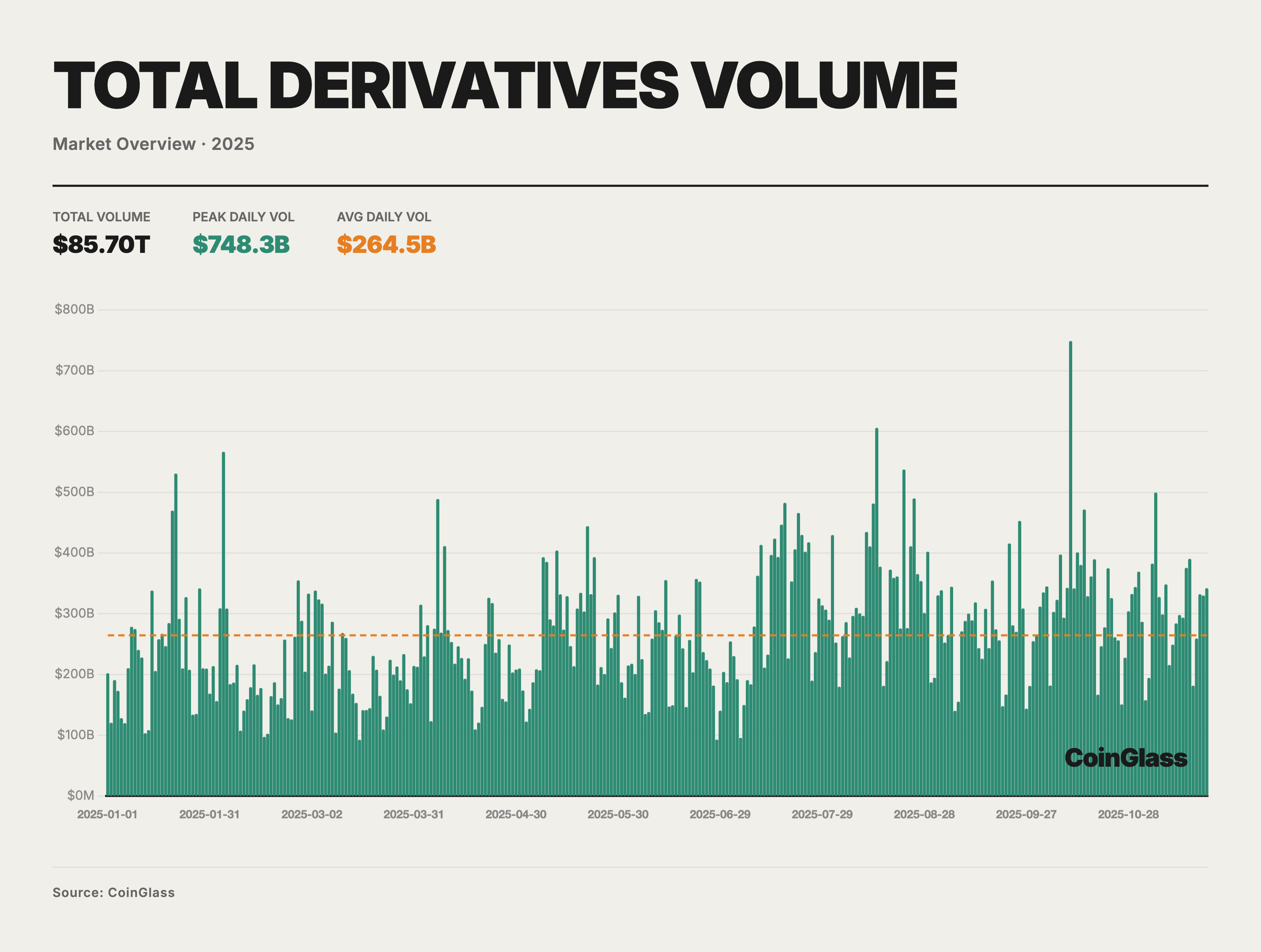
2025 Crypto Derivatives Market Total Volume and Monthly Trend
Source: Coinglass 2025 Annual Report (Significant increase in trading activity on regulated markets)
The greatest appeal of options lies in their 'non-linear returns.' Unlike futures contracts, which are a head-on 'all or nothing' game, options allow you to lock in a future right for a relatively small cost (the premium). If the market moves in your favor, the potential profit is unlimited. If the market moves against you, your maximum loss is only the premium you paid. It's just like buying car insurance: if nothing happens to the car, you only lose the premium; if there's an accident, the insurance company covers the cost.
Breaking Down Core Concepts: Understanding the Basics of Options Trading in Plain Language
Many people get a headache just hearing the word 'Options,' thinking it's a game for mathematicians. In reality, we can understand it using the logic of grocery shopping at a market.
Options are mainly divided into two types:
Call Option: You can think of this as a 'special discount coupon'. Let's say apples currently cost $10 each. You spend $1 to buy a coupon that gives you the right to buy an apple for $12 next month. If the price of apples rises to $20 next month, you've made a great profit ($20 - $12 - $1 = $7). If the price drops to $8, you can just throw the coupon away, and your only loss is the $1 cost.
Put Option: This is like a 'price guarantee certificate'. You're worried the price of apples will plummet, so you spend $1 to buy this certificate, which gives you the right to sell an apple to the merchant for $10 next month. No matter how low the price drops next month (say, to $2), the merchant must buy your apple for $10. This is the classic example of 'buying insurance for your assets.'
Here are a few core terms you need to know:
Strike Price: The agreed-upon price for buying or selling (e.g., the $12 and $10 above).
Premium: The fee you pay for this 'coupon' or 'guarantee certificate'.
Expiration Date: The date when the coupon expires.
Doing the Math: A Complete Breakdown of P&L Calculation for Call and Put Options
Many beginners are afraid to touch options because they don't know how to calculate the numbers. In fact, once you grasp the concept of the 'break-even point,' everything becomes clear. We don't need complex Greek letters, just elementary math.
1. P&L Calculation for Buying a Call Option
Your Expectation: The price will rise significantly.
Cost: The premium.
Break-even Point = Strike Price + Premium
Profit Formula: Market Price - Break-even Point.
For example: You buy a Bitcoin call option with a strike price of $60,000 and pay a premium of $1,000. Your break-even point is $60,000 + $1,000 = $61,000. You only start making a real profit when the price of Bitcoin rises above $61,000. If it goes up to $65,000, you've made a profit of $4,000.
2. P&L Calculation for Buying a Put Option
Your Expectation: The price will fall sharply, or you want to protect your spot assets.
Cost: The premium.
Break-even Point = Strike Price - Premium
Profit Formula: Break-even Point - Market Price.
For example: You buy a Bitcoin put option with a strike price of $50,000 and pay a premium of $1,000. Your break-even point is $50,000 - $1,000 = $49,000. Your options strategy only starts to be profitable when the price drops below $49,000.
Practical Simulation: Demonstrating How Options Achieve Hedging and Profit Through a Case Study
After the theory, let's have a 'practical drill.' This is the most intuitive way to understand the theme of 'buying insurance for your assets: a detailed guide to calculating cryptocurrency options P&L.'
Scenario Setup: You are a long-term holder with 1 Bitcoin, currently priced at $60,000. You firmly believe it will rise in the long run, but your analysis suggests a sharp correction might occur in the next month. You don't want to sell your BTC (for fear of selling too early), nor do you want to endure the pain of asset depreciation.
Strategy: Instead of selling your BTC, you buy a 'put option' that expires in one month.
Strike Price: $58,000 (an out-of-the-money option, slightly below the current price).
Premium: Assumed to be $1,500.
Outcome Scenarios After One Month:
Scenario A: The market crashes, and the price drops to $40,000.
Your spot asset depreciates: $60,000 - $40,000 = a loss of $20,000.
Your option profit: ($58,000 - $40,000) - $1,500 = a profit of $16,500.
Final Result: A $20k loss on spot is offset by a $16.5k gain from the option. Your actual total loss is only $3,500 (mainly the premium cost and the deductible). Without the option, you would have lost a full $20,000. This is the power of insurance!
Scenario B: The market rallies, and the price rises to $70,000.
Your option: Since the price is above the strike price, you won't exercise it, and the option expires worthless. You lose the $1,500 premium.
Your spot asset appreciates: $70,000 - $60,000 = a profit of $10,000.
Final Result: You made a total profit of $8,500. Although you earned a bit less due to the premium, you enjoyed the upside of the rally and maintained a calm mindset throughout, avoiding being shaken out by panic.
Key Variables Affecting P&L: An In-depth Analysis of Premium, Volatility, and Expiration Date
You might ask, 'Is the premium fixed?' Not at all. The price of an option is influenced by several factors, much like an insurance premium changes based on the car's condition and the weather.
The Magic of Time (Theta): An option is like ice cream left at room temperature; its value naturally melts away as time passes. If you buy a 'weekly' or 'daily' option (one that is about to expire), the time decay is very rapid. Therefore, as a buyer, time is your enemy.
The Impact of Volatility (Vega): Volatility is the 'weather' of the market. The stormier the weather (higher volatility), the more expensive the insurance (premium). Buying options during times of extreme market panic is often not cost-effective because you're paying an excessively high premium.
The Cost of Distance: The closer the strike price is to the current price (in-the-money), the more expensive the premium. The farther away it is (out-of-the-money), the cheaper the premium. Buying deep out-of-the-money options is cheap, but it's like buying a lottery ticket—the probability of winning is extremely low.
A Beginner's Guide to Avoiding Pitfalls: Common Misconceptions and Risk Control in Options Trading
Before you embark on your options journey, be sure to watch out for these common mental traps:
Misconception 1: Treating it like a lottery ticket. Many beginners love to buy extremely cheap, deep out-of-the-money options, dreaming of 100x returns overnight. In reality, 90% of these options expire worthless. The professional approach is to use them as a hedging tool, not a gambling instrument.
Misconception 2: Ignoring liquidity. Although the crypto options market is growing, it still lags behind the spot market. For certain less popular expiration dates or strike prices, the bid-ask spread can be very wide, causing you to face an immediate unrealized loss upon purchase.
Misconception 3: 'Naked selling' options as a seller. Everything mentioned earlier was from the perspective of a 'buyer' (paying the premium). If you act as a 'seller' (collecting the premium), your profit is limited, but your risk is theoretically unlimited in extreme market conditions. Beginners should never attempt to 'naked sell' options.
Options are the jewel in the crown of finance; they are both a sword and a shield. For the average investor, understanding and skillfully using this tool can make your investment journey steadier and longer. It is recommended to always choose well-known, regulated platforms with a good user experience for learning and simulated trading. Do not invest significant amounts of capital until you fully understand the risks involved.
Start your safe cryptocurrency journey now
OSL | Secure Ramps. Trusted Rails !
More topics
More topics
Latest
The Hidden Plumbing of Cross-Border Investing: Why "Compliant" Now Matters More Than "Convenient"
Discover why compliance is critical for cross-border investing with stablecoins. Learn about regulatory shifts, AML, and explainable fund trails.
The Hidden Plumbing of Cross-Border Investing: Why "Compliant" Now Matters More Than "Convenient"
When Machines Start Paying: Why Mastercard Put Stablecoins on the Same Rail as Cards
Mastercard's AP4M integrates stablecoins for AI agent payments, marking a convergence of traditional finance and the machine economy.
When Machines Start Paying: Why Mastercard Put Stablecoins on the Same Rail as Cards
$135 a Share, SpaceX: Inside the Fair-Value Fight Over the Biggest IPO Ever
Explore the SpaceX IPO at $135/share. Analysts clash over its $1.77T valuation, AI potential, and Starlink growth ahead of the Nasdaq listing.
$135 a Share, SpaceX: Inside the Fair-Value Fight Over the Biggest IPO Ever
Hormuz Closure Triggers a Risk-Off Day: How Stocks, Oil and Gold Moved as US–Iran Strikes Resume
US-Iran conflict and Strait of Hormuz closure spark market volatility. Analysis of why oil surged while gold fell despite rising tensions.
Hormuz Closure Triggers a Risk-Off Day: How Stocks, Oil and Gold Moved as US–Iran Strikes Resume
How a 24-Year-Old's $8.46B Put Options Bet Front-Ran the AI Chip Drop — Inside Aschenbrenner's 13F
Explore Leopold Aschenbrenner's $8.46B put options on AI chip stocks like Nvidia and Broadcom. Analysis of Situational Awareness LP's Q1 13F filing.
How a 24-Year-Old's $8.46B Put Options Bet Front-Ran the AI Chip Drop — Inside Aschenbrenner's 13F
Recommended for you
More topics
More topics
