The Difference Between Bitcoin and Ethereum: Digital Gold vs. The World Computer
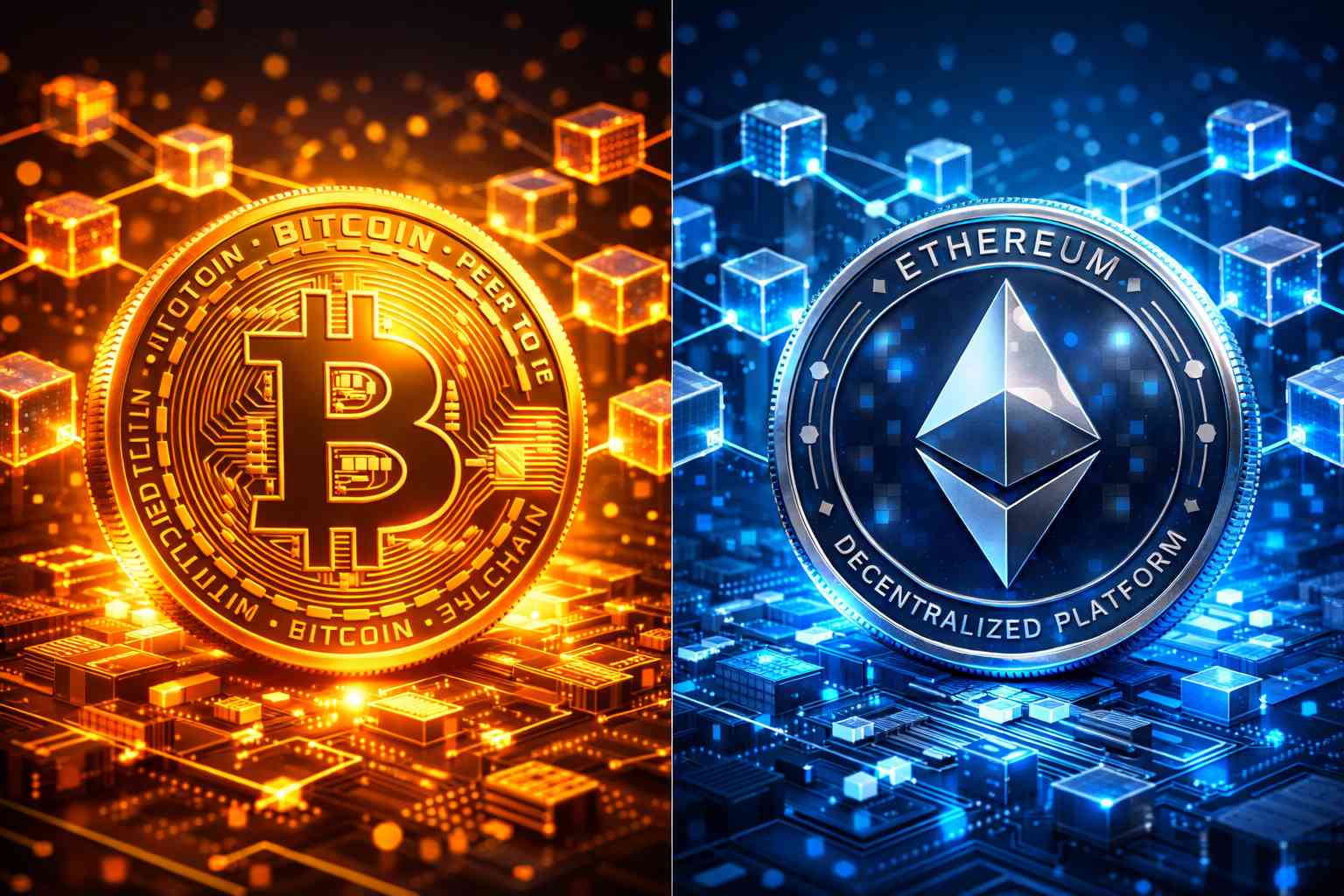
When you first step into the world of crypto assets, the two names you'll hear most often are undoubtedly Bitcoin and Ethereum. To a newcomer, they might seem quite similar—both are products of blockchain technology, and both have fluctuating price numbers on exchanges.
In reality, however, if you place them in the context of the traditional world, the difference between them is as vast as that between a 'gold bar' and the 'internet.' You might be confused: one is a payment system designed to replace fiat currency, while the other is an operating system for building decentralized applications.
Faced with the question Bitcoin vs. Ethereum: Digital Gold or the World Computer, which should you choose?, we first need to deeply understand the soul of each.
Core Concepts: Why is Bitcoin Compared to Gold and Ethereum to a Computer?
Imagine walking into a bank vault that holds an extremely rare metal that cannot be created in greater quantities due to mathematical laws—this is Bitcoin. When Satoshi Nakamoto designed it in 2008, the original intention was very pure: to create a peer-to-peer electronic cash system. But over time, due to its security and scarcity, it has evolved more into a store of value, what we often call 'digital gold'.
Now, imagine you've turned on a globally connected supercomputer where anyone can write programs and launch applications—this is Ethereum. Its founder, Vitalik Buterin, believed that blockchain shouldn't just be for bookkeeping; it should be a platform that can run code. Therefore, Ethereum is called the 'world computer.' It not only carries a currency but also supports a vast ecosystem.
Simply put, Bitcoin's function is to 'store value,' while Ethereum's function is to 'create applications'.
Underlying Logic: The Mechanical Difference from a Ledger to a Smart Contract Platform
To understand the fundamental technical differences between the two, we can use a real-life analogy.
Bitcoin's blockchain is like a 'publicly shared Excel spreadsheet.' Its function is very focused: to record who transferred how much money to whom. Although this ledger is extremely secure and immutable, its capabilities are limited, essentially just for transfers and balance inquiries.
In contrast, Ethereum is more like a 'smartphone operating system' (like iOS or Android). This system not only has a built-in accounting function but, more importantly, it introduces 'Smart Contracts'.
You can think of a smart contract as an 'automated vending machine': no cashier (intermediary) is needed. As long as you insert a coin (meet the condition), the machine will automatically dispense a drink (execute the result). This 'if...then...' code logic allows developers to build lending platforms, trading markets, and even games on Ethereum, not just send tokens.
Economic Model: Absolute Scarcity Cap vs. Dynamic Deflationary Monetary Policy
For readers focused on asset properties, the economic model is a key point to understand.
The reason Bitcoin is seen as a hedge against inflation lies in its 'absolute scarcity.' According to its code, the total supply of Bitcoin is strictly limited to 21 million coins and will never increase. Moreover, roughly every four years, the mining output of Bitcoin is halved. This clearly visible expectation of supply reduction reinforces its status as a 'store of value asset'.
Ethereum is completely different. It has no hard cap on its supply, but this doesn't mean it's infinitely inflationary. With network upgrades (especially the shift to a Proof-of-Stake mechanism), Ethereum introduced a 'burn mechanism'.
This is like the 'world computer' needing to consume a fee called 'Gas' (fuel) for every operation, and a portion of this fee is destroyed by the system. When the network is very congested and the number of users surges, the amount of Ethereum burned can even exceed the amount of new issuance, thus achieving a deflationary effect of 'reducing supply through usage'.
Practical Applications: A Pure Store of Value vs. a Vast Ecosystem Supporting DeFi & NFTs
When we talk about practical applications, the differences between the two directly determine their roles in the industry.
Bitcoin's use case is relatively singular but extremely powerful: it is the decentralized asset with the highest global consensus. According to market observations in 2024, an increasing number of institutions and corporations are starting to include Bitcoin on their balance sheets as part of a diversified portfolio, similar to holding gold reserves.
Ethereum, on the other hand, is the foundation of the thriving Web3 world. The vast majority of decentralized finance (DeFi) applications, non-fungible token (NFT) artworks, and on-chain games in the industry are built on the Ethereum network.
For example, if you want to do more than just store money on the blockchain—say, engage in 'collateralized lending' or 'purchase digital rights'—you will most likely need to use Ethereum. It can be said that Ethereum's value is closely tied to the prosperity of its ecosystem, developer activity, and the total value locked in on-chain applications.
Investment Decision: How to Balance Asset Stability with Technological Growth Potential?
Returning to the initial question: Bitcoin vs. Ethereum: Digital Gold or the World Computer, which should you choose? This really depends on your risk appetite and your judgment of the future.
If you value 'security' and 'certainty' more, and prefer long-term asset preservation, then Bitcoin, as 'digital gold,' is generally considered to have a stronger historical standing and risk resistance. Its volatility, relative to other crypto assets (though still much higher than traditional financial assets), is often lower, making it the primary choice for many entering the space.
If you prioritize 'technological innovation' and 'ecosystem growth,' and are willing to accept the uncertainty that comes with technical upgrades or competition in exchange for potentially higher returns, then Ethereum might be more to your liking. This is because it's not just an asset; it represents the development trend of the blockchain application layer.
It's worth noting that there is also a view in the market that the two are not mutually exclusive but complementary. It's like in a traditional investment portfolio where you might allocate to both gold (defensive) and tech stocks (offensive).
Conclusion and Recommendations: How to Build a Reasonable Portfolio Based on Personal Risk Appetite
Once you understand the fundamental differences between Bitcoin and Ethereum, building a strategy becomes clearer.
Clarify Your Goals: Ask yourself if you are looking for a safe haven for your assets (leaning towards Bitcoin) or if you want to participate in the wave of Web3 technological change (leaning towards Ethereum).
Continuous Learning: The blockchain industry changes rapidly. Technical roadmaps and the macroeconomic environment will affect the performance of both. The best strategy is to keep learning.
Safety First: Regardless of which you prefer, remember to choose well-known, regulated, and compliant platforms with a good security record for learning and experience. Managing your private keys or account security is the first lesson in entering this world.
Finally, don't be intimidated by complex terminology. Whether it's digital gold or the world computer, they are essentially new options brought to us by technological progress. Understanding them is about better embracing the future.
Start your safe cryptocurrency journey now
OSL | Secure Ramps. Trusted Rails !
Latest
Why India's $620B Bond Pilot Changed Nothing Legal
SEBI and the RBI's Demat 2.0 pilot issues corporate bonds as digital tokens and settles them with the wholesale digital rupee, preserving existing legal terms while digitizing the infrastructure beneath a $620...
Why India's $620B Bond Pilot Changed Nothing Legal
Why S&P Global Leads Kaiko: Not Hype, But 24/7 Market Infrastructure
S&P Global led a $110 million extension of Kaiko's Series B to build data infrastructure for round-the-clock tokenized markets.
Why S&P Global Leads Kaiko: Not Hype, But 24/7 Market Infrastructure
When One Firm Holds 5% of Ethereum: Infrastructure Stress Test
Bitmine's accumulation of more than 5 million staked ETH raises questions about whether custody, audit, and validator infrastructure can support single-asset concentration at public-company scale.
When One Firm Holds 5% of Ethereum: Infrastructure Stress Test
Best Enterprise Stablecoin Payment Providers: A 2026 Evaluation Framework
Compare enterprise stablecoin payment providers by use case, legal entity, workflow, controls, integration, reconciliation, support, and contract terms.
Best Enterprise Stablecoin Payment Providers: A 2026 Evaluation Framework
How to Reconcile a USDGO Payment: An Illustrative Finance-Close Example
See how Finance can trace a USDGO payment from an approved obligation through payment records, recipient confirmation, reconciliation, and accounting close.
How to Reconcile a USDGO Payment: An Illustrative Finance-Close Example
A USDGO Reserve Review in Practice: Findings, Limits and Follow-up Questions
Review what the July 2026 USDGO reserve attestation establishes, what it does not prove, and which issuer, redemption, and liquidity questions remain.
A USDGO Reserve Review in Practice: Findings, Limits and Follow-up Questions
Recommended for you
